
For years I’ve had a niggling discomfort when the conversation turns to masculinity. It’s not a political discomfort, it’s something older. It is more a sense that the question is being asked from inside a room with no windows, by people who’ve never questioned whether the room itself is the problem. I had no frame for what I was feeling, yet the itch persisted.
Before we go further I want to be clear that I’m not writing this from the other side of the work. At best, I’m one step ahead on this material—and perhaps only a half step. I don’t know where this leads.
And while I am a scientist, I’m certainly no biologist. I’m a student, a writer. . . a thinker. I’m also a husband, brother, son, and friend.
I built real things on lies I’m about to name: a career; a reputation; a way of moving through the world. I’m now dismantling those lies in myself, even as I ask you to consider dismantling them, too. This is the only honest place to write from.
In The Chalice and the Blade,[1] and more fully in Nurturing Our Humanity[2] (co-authored with Douglas Fry), Riane Eisler identifies two fundamental ways human societies can organize themselves. One links people together through mutual contribution, egalitarian participation, and shared investment in the collective good. The other ranks people, enforces that ranking through threats of violence, and calls the hierarchy natural. Eisler calls this second model Dominator Culture.

Dominator Culture isn’t simply patriarchy, though that is one expression of it. Rather, it’s a civilization-scale operating system that’s been running for approximately five-thousand years. It organizes social reality around who is above whom, who controls whom, and what story justifies the arrangement. The man we recognize today as the masculine ideal isn’t a biological inevitability. He’s specialized software. Written to run on that specific operating system, he is built for expendability, conquest, and emotional silence. Most of us can’t see the OS for the same reason fish can’t see water. We simply call it reality.
Eisler’s critical insight, supported by archaeological evidence from Neolithic and early Bronze Age sites across Europe and the Near East, is that this wasn’t always the case. Partnership-model societies preceded the dominator shift. They weren’t utopias, because they were human and that implies imperfection; but the archaeological record shows a characteristic absence of fortifications, thrusting weapons, and the social stratification that Dominator Cultures require. The shift to dominance wasn’t inevitable. It was chosen, institutionalized, and then taught to every subsequent generation as though it were simply the way things are.
Here’s the observation that finally cracked it open for me.
There’s a small and specific category of species on this planet where menopause doesn’t end a female’s contribution to the group. Rather, it begins her leadership of it. The post-reproductive female becomes the tribe’s navigator, its memory, its strategic intelligence: the one who’s lived long enough to know where the salmon run when everything else fails.
Five of these so-called ‘grandmother species’ are orcas; short-finned pilot whales; narwhals; belugas, and humans. All five are peak predators but not one is so because of raw physical power. They’re at the apex because of accumulated wisdom, held in community, transmitted across generations by the ones who’ve lived long enough to carry it
When I sit with that fact, something that’s been itching in me for forty years finally makes sense. The most sophisticated predatory intelligence on this planet doesn’t organize itself around the dominance of its strongest males. It organizes itself around the wisdom of its elders, operating in community, across time. That’s not a cultural preference: it’s a biological pattern, replicated independently across those five species, including ours.

Surfacing orca. Photo by Thomas de Luze
So, when someone tells me that masculinity is fundamentally about strength, or dominance, or emotional silence, I keep coming back to the Orca. The grandmother Orca—who hasn’t reproduced in decades, who leads her pod until her last breath, and whose leadership includes ensuring the next grandmother is ready when she’s gone—isn’t a footnote in the story of how Orcas became apex predators. She’s the mechanism.
And now the grandmother Orca has a frame to live inside. She’s not a free-floating biological claim. She’s the living, breathing partnership model.
So yes, masculinity is ‘under attack.’ But let’s be precise about what’s being attacked, as that precision is where everything changes. The lies about masculinity are under attack. In fact, the lies have always been the attack.
Four lies were the primary tools of that teaching. And here, for the first time, they have names.
The Lie That Protects All the Others: Progress Is Linear
Before we examine what Dominator Culture taught men to believe about themselves, we need to close the escape hatch that allows those beliefs to feel permanent. A skeptical reader can always retreat to a single comfortable position:
“Sure, maybe earlier societies were more egalitarian, but we have progressed.
That is what civilization means. Whatever came before was primitive.”
That is the fourth lie—presented here as the first—and it’s Dominator Culture’s most elegant defense. Yet it is demonstrably false. The evidence is not philosophical: it’s engineering.
The Romans, for example, developed a concrete formula for marine harbor construction that has outlasted every modern equivalent. Structures built with it two-thousand years ago are still intact, still structurally sound, still resisting the Mediterranean. We have analyzed its composition but we haven’t been able to replicate its performance. The knowledge was not transferred. It was lost, and for centuries after Rome’s collapse, the best available construction technology was dramatically inferior to what Rome had already solved.

Fifth-century chromium-treated bronze sword.
Permanent collection, Hubei Provincial Museum, Wuhan, China.
Photo by WindMemories
The Chinese developed chromium-treated steel weapons with a corrosion resistance that would not be matched again for two millennia. That knowledge disappeared entirely from the historical record.
It was reinvented in the 1950s. Not recovered, reinvented from scratch, by engineers who had no idea it had already been done.
The Antikythera Mechanism, recovered from a Greek shipwreck and dated to approximately 100 BCE, is a fully functional astronomical computer. Hand-machined bronze gears. Differential mechanisms. The capacity to predict eclipses, track planetary positions, and model the Metonic cycle. It is not a primitive approximation of a computer. It is a computer, built twenty-one centuries ago, whose internal manufacturing tolerances we still cannot fully explain. The level of mechanical knowledge required to produce it did not reappear in the historical record until the fourteenth-century European clockmakers. An entire tradition of precision mechanical engineering vanished completely for fourteen hundred years.
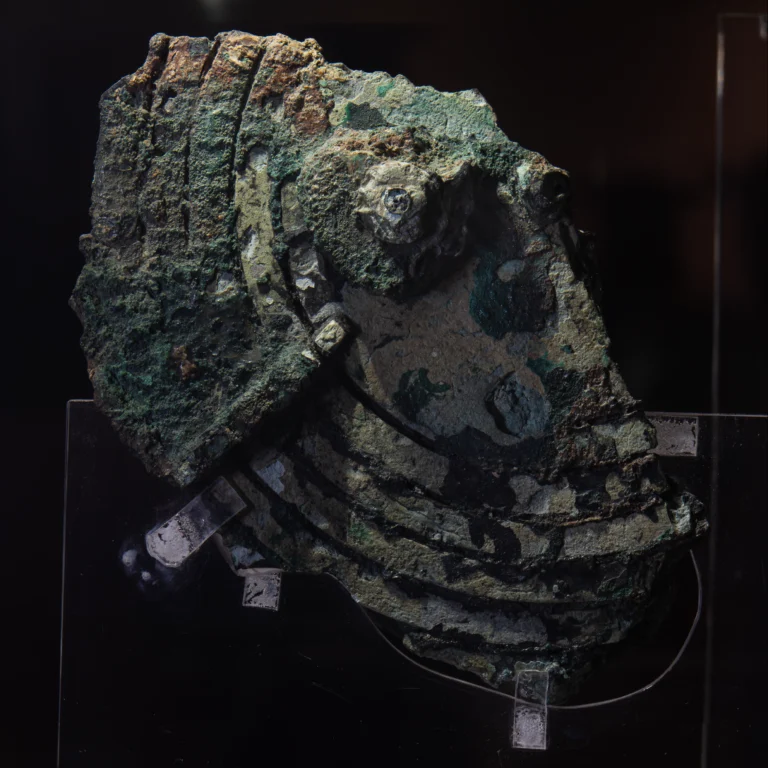
Portion B of Antikthyria Mechanism, including partial gear shaft and scale. Greek, estimated 205-60 BCE.
Permanent collection of the National Archaeological Museum, Athens, Greece.
Photo by Logg Tandy
The Mayans farmed at night. Limestone reflects moonlight efficiently enough to illuminate field rows. They laid limestone paths through their agricultural systems to harvest that reflected light, planting and working through the cool darkness to avoid the punishing heat of the Yucatan day. This produced yields that sustained cities of hundreds of thousands of people in a climate that modern agriculture still finds brutally challenging. That knowledge is gone. The cities are ruins. We call the people who built them ancient, as though antiquity and inferiority are synonyms. Ancient means earlier in time but it says nothing about the quality of what was known.
This is precisely what happened to partnership-model masculinity. Eisler’s archaeological record shows that something genuinely different existed before the dominator shift: men who were fierce and relational, protective and emotionally present, strong in the ways humans are actually strong. When the dominator OS was installed, the Partnership software was not deleted cleanly. Instead it was buried under five thousand years of overwrite. And the fourth lie, the lie of linear progress, was the mechanism that prevented anyone from going looking for it.
If progress is linear then what came before was lesser, and there is nothing worth excavating. If, however, progress is a coastline—fractal and recursive, advancing in some places while losing ground in others—then what came before might be exactly what we need. And the work of communities like Mentor, Discover, Inspire (MDI)[3] is not to fix broken men. It is to excavate buried ones.
Remove the fourth lie and the other three are revealed as what they always were: tools of a specific cultural architecture, installed for specific political purposes, at a specific moment in history. Not nature. Not inevitability. Just choices, made by people, that other people can unmake.
Lie One: Men Are Stronger
Here is the first lie: that male physical strength represents a biological apex, an inherent superiority that justifies male authority. And here is the honest biology: step outside the human frame of reference and find that a 135-pound female chimpanzee outpulls an elite 200-pound human male athlete, not by a small margin, but decisively. The most rigorous modern analysis, O’Neill et al (2017) in PNAS, puts the mass-specific muscular performance advantage of chimpanzees over humans at 35 to 50 percent. That’s not the she-chimp’s advantage over human women, it’s them versus human men. This isn’t simply a humbling footnote: it’s the entire argument.

Composite image by Jonathan Campeon.
The human lineage spent seven to eight million years of hominin evolution moving deliberately away from raw power. Chimpanzee muscle runs roughly 67 percent fast-twitch fiber, optimized for explosive torque, a physiology built for short violent bursts of maximum output. Human muscle reversed that ratio. We run 50 to 70 percent slow-twitch, built for repetitive low-cost endurance. We added cortical inhibition, a neurological governor that prevents humans from recruiting maximum muscle capacity, because doing so would destroy our joints and bones. We are, in the most literal biochemical sense, engineered for restraint.
In short, we traded the silverback’s raw power for something far more dangerous. And understanding what that something is requires us to look honestly at what kind of predator we actually are.
The Trickster at the Top of the Food Chain
If there is a god who captures the true nature of human predatory strategy, it is not the warrior king, thundering and muscled. It is the trickster. We are apex predators, genuine and unambiguous, but our weapon of choice is deeply ironic. We cannot harm a mammoth with our hands. We cannot outrun a kudu. We cannot out-bite, out-claw, or out-muscle virtually anything in our prey category. What we can do is look like a threat, and sound like one. And we can think three steps ahead.

Cave painting of an aurochs, Lascaux, France. Age estimated ≈ 19,000.
So, we plant sharpened logs in the ground and panic a mammoth onto them. We dig a trench at the base of a cliff and stampede bison over the edge. We track a giant aurochs bull—a huge, exinct cattle progenitor—which no single human, no matter how impressively muscled, could have harmed with bare hands. So we didn’t try. We outthought it.
We are the quintessential Loki. The persistence hunt belongs here too. A human hunter in the Kalahari can track a kudu through the midday heat for twenty miles. The animal, built for high-speed bursts but not sustained thermoregulation, collapses from exhaustion. We win because we are tireless, not because we are powerful. The slow-twitch efficiency that makes us physically unimpressive in a cage match is the exact adaptation that made us the most successful terrestrial predator in the history of the planet.
Now, here is the thread that runs through every single one of those strategies without exception: none of them are possible alone. There is no version of the lone alpha, no matter how personally courageous, who can execute the mammoth drive, the cliff stampede, or the persistence hunt. A community is needed. Someone cuts timber and sharpens logs. Another drives the animal from the flank. Yet another waits at the trench. One tracks while another carries water. The trackers read sign from the day before. The hunters know the landscape because their grandparents taught it to them.

Photo by Cemrecan Yurtman
Human strength was never a solo performance, was always a community instrument. Dominator Culture extracted the physically strongest individual from this collective performance, placed him at the apex of a hierarchy, and told the story that he was the reason the hunt succeeded. In fact, he was one tool in a communal toolkit, useful on specific days for specific tasks, in service of a collective strategy that his body alone could never have designed or executed.
The Arrow Does Not Ask
This brings us to the claim that strength was ever the deciding variable. The arrow is just as deadly weilded by someone slight as by one weighing 220 pounds. The blade-master’s technique does not change based on the configuration of the body holding the blade. The strategist who designs the cliff drive need not be the largest person in the group. She needs to understand terrain, animal behavior, and collective coordination. Strength was always just one community asset among many, deployed when the strategy called for it, replaced by other assets when it did not.
The idea that physical strength confers authority was not a biological discovery. It was a political decision, made by Dominator Culture when it needed a justification for ranking, and enforced generation after generation at spear-point. The Warrior King myth required men to perform a dominance that our own biology had already, deliberately, evolved away from. We were asked to be silverbacks (not a predator, ironically). We are Loki. The performance has always been a lie, and the Dominator OS wrote it into the code so early that most men never found the original.
There is also a metabolic cost to running this particular malware. High testosterone, the physiological signature of the Warrior King phenotype, increases daily caloric expenditure, suppresses immune function, elevates the reactive oxygen species that accelerate cellular aging, and trades long-term somatic maintenance for short-term competitive edge. Research on subsistence populations including the Tsimane and the Hadza shows a direct and measurable energetic tax on high-testosterone males. This is not privilege. It is a biological liability that Dominator Culture convinced men to pay willingly, in exchange for authority in a hierarchy built to exploit them alongside everyone else.
Lie Two: Men Are More Skilled
The second lie was subtler, because it disguised itself as meritocracy. The claim was never stated as: we will exclude you from the training pipeline and then cite your absence as evidence of your incapacity. That would have been too honest. The claim was simply that certain domains—tactical, technical, mechanical, and leadership—were naturally male. The evidence offered was the historical absence of women from those domains.
The US Armed Forces has spent a decade dismantling this with its own data. Since the 2015 order lifting all combat role restrictions, over 150 women have completed Ranger School, one of the most physically and mentally demanding training programs on earth. A significant number have passed Green Beret training. On gender-neutral standards that are elite, uniform, and sex-neutral, the performance gap did not merely narrow: it collapsed. In specific technical and marksmanship assessments, women scored higher.

Major Shawna R. Kimbrell, USAF 555th Fighter Squadron at Aviano Airbase, Italy.
Photo by Airman 1st Class Ashley Wood (2008)
A 2025 University of Waterloo study, using high-fidelity flight simulators and eye-tracking, found that female pilots matched their male counterparts on every visual attention metric and outperformed them on flight control accuracy under elevated stress, the exact conditions where you most need to be right.
The 2015 Marine Corps study, an outlier, found gender-integrated units performing worse and it’s been cited as definitive ever since. Yet independent analysts have repeatedly identified it as a study that evaluated teams with inadequate integration history and improperly fitted equipment: body armor, helmets, and ruck systems designed for a male physiological average. The system failed. The woman was blamed. That is not data. That is the Training Fallacy, the institutional reflex to misdiagnose access problems as aptitude deficits, and then use the outcome as justification for continued exclusion.
The Confidence Trap
The leadership data is even less flattering to the dominator model. Research by Tomas Chamorro-Premuzic documents that narcissism, approximately 40 percent more prevalent in men than in women and significantly overrepresented in leadership positions,[4] is routinely mistaken for leadership potential. Overconfidence gets promoted. Genuine competence, if it does not perform the right theater, gets filtered out. The dominator model selects for the performance of strength and then is surprised when the performance is not strength.
Napoleon marched 600,000 men into Russia in 1812. Fewer than 100,000 came back. He was not undone by Russian military genius. He was undone by the same overconfidence the dominator model selects for at every level: the unshakeable conviction that the man at the top of the hierarchy cannot be wrong. The Germans replicated this error with remarkable precision in 1941, opening the Eastern Front while the Western campaign was still unresolved.
German engineering at that moment was extraordinary. Jet aircraft were approaching readiness. Submarine warfare was strangling Allied supply lines. A military machine that had overrun most of Europe in months. With a single front, the outcome of that war is genuinely debatable. The Allies were not winning on strategy alone. But the ideology demanded expansion, demanded demonstration. It could not tolerate the patience that a two-front war required, because patience looks like weakness inside a dominator hierarchy. So they opened the second front and that hubris lost Germany that war.
This is what Dominator Culture does to skill: it promotes the performance of competence over competence itself. Then, under sufficient pressure, it fails catastrophically and calls the wreckage fate.
Lie Three: Men Are Less Emotional
The third lie may be the one that is killing us most directly. And it begins earlier than most men know. Terrence Real, in I Don’t Want to Talk About It, identifies what he calls the Great Severance: the normative developmental trauma through which boys are systematically disconnected from their relational and emotional selves to satisfy the demands of traditional masculinity. It begins between the ages of five and seven, when boys enter peer groups and educational environments where the manhood script is enforced.
The mechanism is the systematic shaming of vulnerability, beginning often with the boy’s relationship to the most authentic emotional connection in his early life. The message is consistent and relentless: that part of you is not acceptable here. Turn it off. Become useful.

Original photo by Couleur. Background by GeminiAi
What gets built in its place is the mask, a defensive architecture of invulnerability that protects the boy from social exile and costs him his internal world. It is the dominator OS installing itself at the application layer of a child’s developing identity.
Men are not less emotional. We never were. We are extensively trained from early childhood in the active suppression of approximately 80 percent of the emotional spectrum: fear, grief, tenderness, longing, shame, the desire to be known. What remains available as a sanctioned outlet is anger, which Dominator Culture rebranded as strength, and silence, which it rebranded as stoicism. The emotional range did not disappear. It went underground, where it does its damage without a name.
The Neurological Cost
The clinical term for what develops is Normative Male Alexithymia, a socialized deficit, not a biological one, in which men literally lack the linguistic and cognitive framework to identify their own emotional states. Semantic priming research shows the suppression happening at 500 milliseconds stimulus onset asynchrony, the level of semi-conscious processing. The mask is not a choice men make consciously each morning. It is trained into the neurological architecture during the years when the brain is most plastic and becomes the substrate. The original programming is buried so deep that most men never find it, and those who go looking are told by the OS itself that there is nothing worth finding.
Real describes the result as covert depression, an autoimmune disease of the psyche where the self attacks the self. Where overt depression presents as sadness and withdrawal, covert depression presents as rage, irritability, workaholism, risk-taking, and substance use. These are not symptoms of a robust ego. They are the behavior of a man who cannot locate his own grief and is using every available substitute to feel something. He steps over the pain so many times that he loses the address. What remains is a low-grade baseline of shame with no name, that never gets diagnosed because it does not look like depression. It looks difficult. It looks like a problem other people are having.
The Body Keeps Score
The neurobiology closes the argument. When a social mammal perceives chronic isolation, and the Lone Wolf ideal that Dominator Culture demands of men registers as perceived isolation by every biological measure, the HPA axis activates and cortisol floods the system. In acute doses it is protective. Chronically it is neurotoxic, immunotoxic, and structurally damaging to the hippocampus. Research shows that narcissistic traits, frequently a fragile masculine defense mechanism, correlate with significantly elevated basal cortisol in men but not women. The man performing invulnerability is running a biological emergency response on a continuous loop.
Men who score high on Masculine Gender Role Stress face dramatically elevated cardiovascular risk. Men who score toward the expressive end of the gender spectrum, who maintain close social bonds, seek help, and allow themselves emotional range, are 35 percent less likely to die from coronary heart disease. Men die from Broken Heart Syndrome at twice the rate of women, not because they develop it more often, but because they have less social co-regulation available when the acute crisis arrives. The Lone Wolf has no vagal brake.
Men die by suicide at 3 to 4 times the rate of women globally.[5] In the United Kingdom, three-quarters of all registered suicides are male. Men represent only 36 percent of mental health referrals,[6] not because they need support less, but because seeking it violates the third lie at the deepest layer of socialized identity. These are not the statistics of a class that has everything under control. These are the statistics of a population that was told that asking for help is failure, and integrated that lesson at a cellular level, beginning at age five.
What Is Actually Under Attack
So yes. Something is under attack. But the diagnosis has to be careful here, because the attack is coming from two directions simultaneously, and both are necessary.
The external attack is real. Dominator Culture’s myths are being challenged by biology, by institutional data, by clinical evidence, and by the accumulated weight of what the lies have cost us. The structure is cracking from outside because the evidence can no longer be contained. The operating system is being audited from the outside, and it is failing every test.
The internal attack is equally real. Men are experiencing the collapse of an identity that was never built for human beings. And when the pillars fall, what is underneath is not emptiness. It is a person who was never fully met, who learned to perform instead of inhabit, whose grief has nowhere to go and whose loneliness has no name. The breakdown is happening from the inside too. And it should. And it must.

Door to a solitary confinement cell, Fort Christiansvaern, St. Croix, US Virgin Islands
Photographer unknown (2005)
Because here is what dominator culture’s deepest lie obscures: there is no reality in isolation. Solitary confinement does not merely inconvenience; it induces psychosis. Since the self requires witness to remain coherent, there is only reality in community. And so the reversion to a healthy model cannot be done alone, because nothing human ever could be done alone.
The War Men Lost Before It Started
There is a darker irony underneath all of this that deserves to be named plainly. A single man can biologically repopulate an entire village after catastrophic loss. This makes men, in the cold arithmetic of species survival, far less individually valuable than women. Dominator culture understood this problem, perhaps not consciously, not in a boardroom, but at the level of cultural logic. It then solved it with extraordinary cleverness.
It refashioned the masculine ideal into something that would willingly march toward death for the extension of power. It made expendability glorious. It called the willingness to die in droves honor, valor, sacrifice. It built entire religious and civic architectures around the idea that a man’s highest expression was to spend himself completely in service of a hierarchy he did not control and would not survive.
The mechanism was the same one running through every lie. The Great Severance cut boys off from the relational intelligence that might have asked harder questions. The Strength Lie told them their bodies were weapons to be used. The Skill Lie told them their value was in their utility. The Emotional Lie told them the grief of being expendable was not something they were permitted to feel. And the Linear Progress Lie told them this was simply what civilization looked like, that it had always been this way and always would be.
Dominator masculinity was, in a profoundly dark way, a cultural inoculation against the recognition of male expendability. It convinced men that dying in droves was the highest expression of their worth. The Lone Wolf is not a hero. He is a pre-programmed tool of the hierarchy, shamed into silence so he will not notice he is being spent. And men are the primary victims of that story—in body counts across millennia of war, in suicide rates today, in the cardiovascular cost of a lifetime performing invulnerability, and in the emotional poverty of lives lived behind a mask stitched on in childhood.

Photo by Jonathan Perez.
Men also built this. Not alone, and not with full awareness, but in collaboration, trained together, shamed together, rewarded together. The mask was a community project. The dominator model was assembled by human hands, from human fear, in service of human power. Which means exactly one thing: it can be disassembled the same way.
What Remains. . .
This is where most essays of this kind reach for a blueprint. A new set of roles. A better job description for men in the modern world. And in doing so they fall back inside the same frame they were trying to escape, because the dominator OS has conditioned us to believe that a man without a role is not a man at all.
Einstein observed that a problem cannot be solved from within the consciousness that created it. The roles answer is still inside the bottle. It is still asking: what is a man for? And that question is itself the malware.
Strip away the dominator OS. Strip away the four lies. Strip away the performance, the hierarchy, the metabolic tax of the Warrior King, the mask stitched on at age six, the Great Severance, the expendability bargain, the cortisol loop, the covert depression, the training fallacy, the linear progress lie. What remains is not a role. What remains is a man.
Sentient. Feeling. Present in his body and in his community. Competent, not as a credential he must continuously prove, but as the natural condition of a person who is actually here, paying attention, and doing what the moment requires. Communal, not as a strategy or a therapeutic intervention, but as the biological fact of what we have always been: a species for whom isolation is psychosis and belonging is oxygen.
The partnership move is not from Warrior King to a better set of roles. It is not a lateral transfer within the same operating system. It is a return to general-purpose humanity. A man who happens to be a man, the same way he happens to have brown eyes or long legs. Not defined by it. Not performing it. Not spending himself in service of it. Simply living inside it, fully, without apology and without theater.
Competent, Present, Communal
These three words are not a role description. They are a description of what is already there when the lies are gone.
Competent means a man who can be trusted to do what he says, feel what he feels, and know the difference between the two. Not a man who is stronger than other men, or more skilled, or less emotional. A man who is actually, reliably, himself. Competence in this sense is not a performance category. It is the opposite of performance. It is the condition of someone who no longer needs to perform because he has nothing to hide.
Present means a man who is actually in the room. Not managing the room from behind the mask. Not running the dominator OS in the background while his face does something else. Present means the grief is where the grief is, the love is where the love is, the fear is named and the courage is real. A man who is present is not a man without strength. He is a man whose strength is no longer theoretical.
Communal means a man who knows, at a cellular level, that there is no version of himself that exists outside of relationship. Not because the community needs him to fill a function. Because he is, like every human before him across eight million years of evolution, only fully real inside a web of mutual witness. The Lone Wolf is not a hero. He is a man running the dominator OS on hardware that was never designed for isolation. The community is not where a man goes to be useful. It is where a man goes to exist.
The Excavation
The Antikythera Mechanism was not rebuilt by engineers who sat down and invented a new kind of mechanical computer. It was recovered by people who looked at what survived, took it seriously, and refused to accept that the loss was permanent. Roman concrete is not being recreated from imagination. It is being understood by examining what still stands after two thousand years.
The partnership-model masculinity that preceded the dominator shift is not gone. It is buried. It is still present in the biology, in the eight-million years of slow-twitch endurance and cortical inhibition and social-mammal neurology that the dominator OS never succeeded in overwriting. It is present in the moments when a man drops the mask, usually by accident, usually in crisis, and discovers that the people around him do not run away. It is present in every man who has ever sat in a room like this one and felt, for the first time in years, that he did not have to perform.
The recovery from the Great Severance is not an individual project. It never could be. The mask was a community project, built in collaboration, maintained in collaboration, and it will be dismantled the same way. The man sitting behind it did not build it alone. He will not take it down alone. And the general-purpose humanity waiting underneath it was always, from the very beginning, a collective intelligence. We became apex predators in community. We will become fully human again the same way.
Monday Morning
There is one more thing that needs to be said, and it is not philosophical. Some of the men reading this have organized forty years around the lies. A career built on the Skill Lie. A marriage navigated from behind the mask. Sons raised with the same Great Severance because it was the only inheritance available. The deconstruction in this essay is accurate, and for some men it will land not as liberation but as accusation. If the Warrior King was malware, then what does that make the forty years spent running it?
It makes them human. It makes them the product of a system so total, so old, so fluent in the language of nature and inevitability, that resisting it without a map was nearly impossible. The man who ran the dominator OS faithfully was not a fool and not a villain. He was a person doing the only thing the culture had given him language for. He was, in the most precise sense, doing his best with what he had.
That is not an absolution. It is an accurate description, and accurate descriptions are where excavation begins.

Aegean sponge. Photo by Josch13
The Antikythera Mechanism was found in 1900 by a sponge diver named Elias Stadiatis. He was not an archaeologist. He was not looking for lost civilizations. He was doing his work, in the water, with his crew, on an ordinary day in the Aegean. He saw something strange in the wreck on the ocean floor. He brought it up. He did not know what it was. Neither did anyone else, for decades. But he brought it up, and that act of ordinary attention in the course of ordinary work was the thing that changed everything.
That is how buried wisdom tends to surface. Not in a single revelation. Not in an essay, however well argued. It surfaces in the ordinary moments when the performance drops, usually by accident, and something true comes through the gap. The man who tells his son he is scared. The man who sits with a friend in silence and does not try to fix anything. The man who admits, in a room like this one, that he does not know what he is doing, and discovers that the room does not collapse around him. The man who cries at something and does not apologize.
Each of those moments is a piece of the mechanism coming up from the wreck. Each one is a data point against the four lies. Each one is a man discovering, in real time, that the general-purpose human underneath the performance was there the whole time, waiting without drama, needing only to be allowed.
This is the work. Not the grand gesture. Not the philosophical overhaul. Not a new identity to replace the old one. Just the accumulated weight of ordinary moments in which a man chooses presence over performance, one Monday morning at a time, in community with other men doing the same thing.
The community is not where you go to be fixed. It is where you go to be witnessed. And being witnessed, it turns out, is not a soft skill or a therapeutic nicety. It is the oldest human technology we have. It preceded the mammoth drive and the persistence hunt and the sharpened logs. It is what made all of those possible. It is what makes everything possible.
The attack we are experiencing is not an assault on something real and good. It is the accumulated pressure of evidence bearing down on a structure built on four lies, and simultaneously the internal pressure of men who have carried the weight of those lies long enough to feel them breaking.
Both pressures are necessary. Both are doing exactly what they need to do.
What was known can be relearned. What was lost can be found. What was buried under five thousand years of dominator mythology is not gone. It is in the room with us right now, underneath the performance, waiting without judgment for the performance to end.
That is not an obituary. That is the work this community exists to do.
References:
[1] Riane Eisler, The Chalice and the Blade: Our History, Our Future (San Francisco: Harper & Row, 1987)
[2] Riane Eisler and Douglas P. Fry, Nurturing Our Humanity: How Domination and Partnership Shape Our Brains and Lives (New York: Oxford University Press, 2019)
[3]Mentor, Discover, Inspire (MDI is the parent organization and publisher of Legacy Magazine. The mission of MDI is to cause greatness, by mentoring men to live with excellence; and, as mature, masculine leaders, create successful families, careers, and communities.
[4]Tomas Chamorro-Premuzic, Why Do So Many Incompetent Men Become Leaders?: (And How to Fix It) (Boston, Massachusetts: Harvard Business Review Press, 2019)
[5]Kathryn L Lovero, Palmira F Dos Santos, Amalio X Come, Milton L Wainberg, Maria A Oquendoo, “Suicide in Global Mental Health,” Current Psychiatry Reports, 2023 May 13;25(6):255–262
[6]Ilyas Sagar-Ouriaghli, Emma Godfrey, Livia Bridge, Laura Meade, June SL Brown, “Improving Mental Health Service Utilization Among Men: A Systematic Review and Synthesis of Behavior Change Techniques Within Interventions Targeting Help-Seeking,” (Am J Mens Health, 2019 Jun 11;13)

Dr. Lucas Root is a Ph.D. strategist, builder, and operator known for architecting Pokémon’s half-billion-dollar vending network. Today, he works with founders, investors, and leaders to scale AI-driven systems, communities, and ventures with precision and depth.