
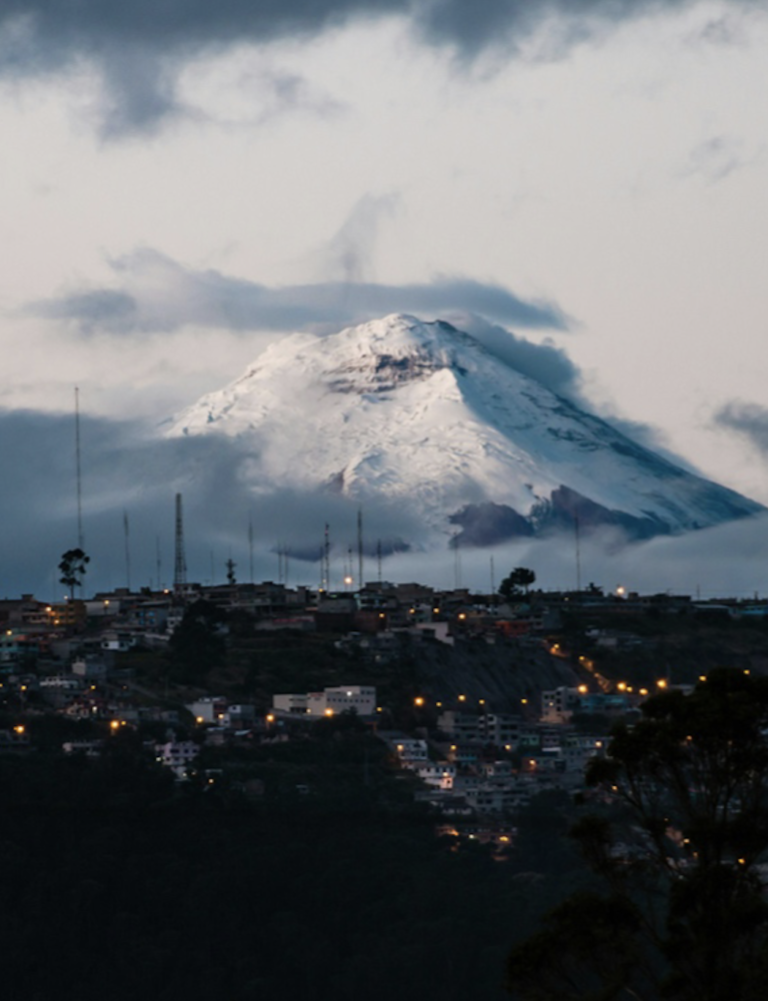

A Scandal at 8,000 Feet
By Juanito ‘Sonny’ José
Back in 2006, after serving as head of an offshore hedge fund management firm, I decided to sell my company shares. I then ventured into private investing, equipped with the tools learned from a dual-track career in economics and finance.
In retrospect, I was blessed to have been thrust into jobs that exposed me to both worlds, understanding the macro and the micro bits of things.
After five years of doing my own private-investing gig, I heard of this place called Ecuador. I had read in International Living that Ecuador was a retirement hotspot for gringos, especially the city of Cuenca. I decided to be the most recent extranjero to look into the place.
Ecuador is one of only three countries in Latin America whose national currency is the U.S. dollar, the others being Panama and El Salvador. The country went through bursts of inflation and tailspin during the nineties and the International Monetary Fund would only agree to a rescue package if Ecuador switched from their own sucre to the greenback.
The capital, Quito, is nestled in a valley high in the Andes, at an elevation of 2,835 meters (9,300 ft.), second only to Bolivia’s La Paz. If Quito was the first city in Ecuador to be declared a UNESCO world heritage site, Cuenca, where I spent several months, was the second. At around 2,590 meters (8,500 ft.), this old ciudad (city) reached the peak of its importance after 1820 when Ecuador achieved independence. When one asks locals about must-see places in Ecuador they all say—with pride—that Cuenca is numero uno, number one, on the list.
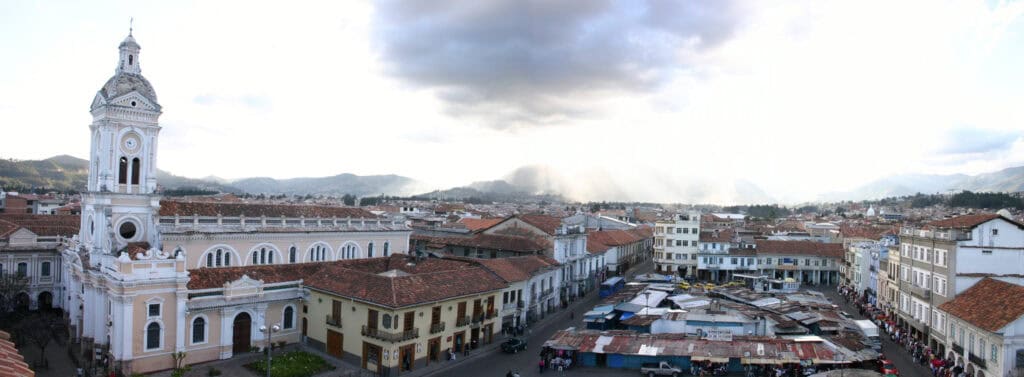
Cuenca, Ecuador. Photo by Hjvannes.
Cuenca had earned a reputation as a hotspot for gringos jubilados, North American retirees, and I could see why. Some 9,000 of them—drawn by the low cost of living, the mystique and charm of the colonial city, the eternally Spring-like weather, and the backdrop of snow-capped Andean peaks—have settled there, with one more soon to follow.
Shortly, the same itinerant Welshman who had told me of the charms of Cuenca also tipped me off to the value of investing with a small cooperative bank called Cooperativa de Ahorro y Credito Coopera Limitada de Azuay, or Coopera for short.
This appeared to be one of those rare institutions that had made itself indispensable to the local community— to the low-wage local workers as well as los extranjeros—by doing everything right.
The bank, according to a Welsh friend, was offering gringos like me some of the highest interest on US-dollar deposits available anywhere in the world, rates of up to 11 percent. High interest, stunning scenery, low expenses and a stable democracy. Hey presto! No wonder I decided to move some money there.
But before I could get started with Coopera I met Juan “Juanito” Antonio, a young Ecuadorian from Queens, New York, who had repatriated to his father’s homeland after college. His English was perfect and that, along with an amiable and affable demeanor, made him the ideal point man—de facto private banker—for Coopera’s clientelle of extranjeros.
I am also a Juanito and, as tocayos, our shared name gave young Juanito and I a kind of instant chemistry. It was due to this bond that I managed to convince him to have Coopera grant me the higher rate of return befitting such a large deposit. By local standards, it was a relatively large deposit from a foreigner.
The meeting went off well and wire transfers opening the accounts soon followed. As a man experienced in finance and managing other people’s money, I felt smug: this was a great deal.
According to Juanito, Coopera’s business idea sprouted from Italian development aid experts. It was simple: the indigenous population, comprising twenty-five percent of Cuenca, typically have limited access to credit. They often had no dealings with banks, which were the domain of the more affluent and educated.
The Italians who conceived Coopera introduced an innovation that sparked my curiosity. Although it appeared to be a standard social enterprise, fueled by profits and business efficiency, it was also driven by social imperatives and was suffused with noble purpose. I call that impact investing, which was an emerging trend at that time.
First, Coopera built an office to take in deposits as a cooperative, like a standard for-profit rural bank. Then, they began lending to their members, who were smallholder-depositors according to the coop model.
They might, for example, give a crop loan to a fruit farmer. Thanks to Ecuador’s rich mix of volcanic soil, temperate climate, and industrious campesinos (farmers), local strawberries there grew as big as my clenched fist; but up to then loans to the value of a single strawberry had been hard to come by.

Woven by hand in Cuenca from toquillo straw, so-called Panama hats
are in fact from Ecuador. Photo by Theodore Scott.
Credit lines were also granted to furniture makers; and to the village women weaving the hats called Panama, though these originated in Cuenca.
There were loans to cab drivers and transport drivers; market vendors; poultry growers; fish merchants in Guayaquil who bring fresh pescados (fish), gambas (prawns), mejillones (mussels), vieiras (scallops), and other fruits of the sea up to the highlands.1
Handicraft makers, too, got loans and especially the craftsmen working spondylus,2 a type of mollusk used for clothing and jewelry. Many other smallholders, indigenous entrepreneurs, and businesswomen received credit lines and microloans from Coopera, people who would never have enjoyed the same privilege from the old traditional banks.
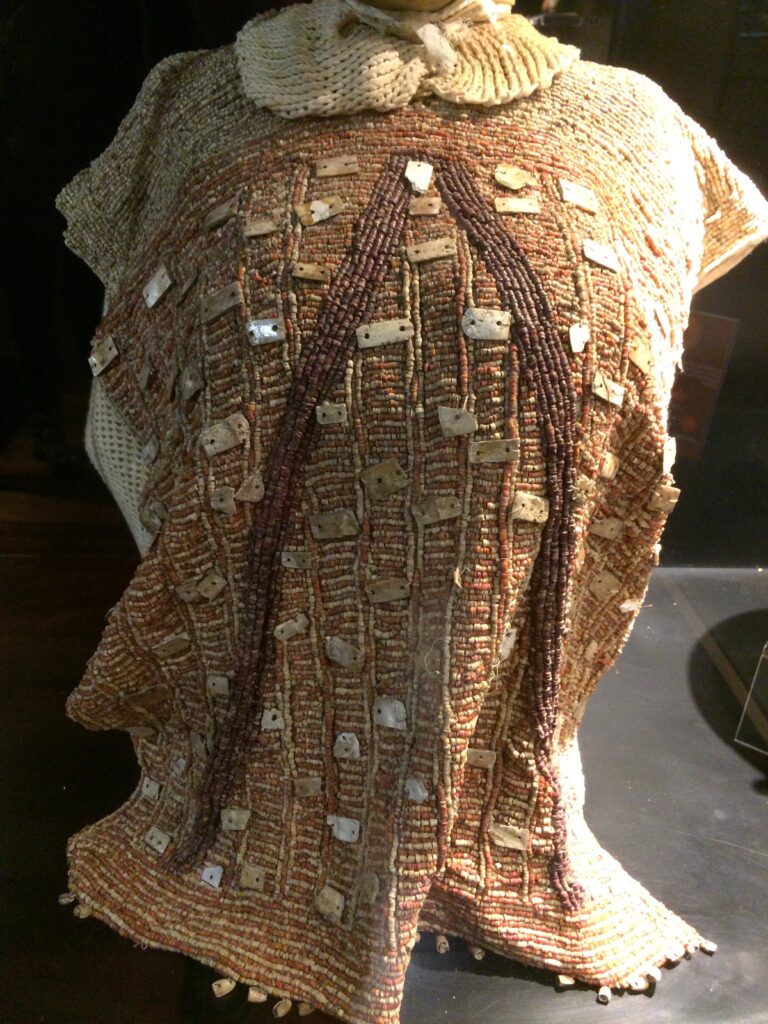
Garment made from spondylus conch beads. Photo by Ranoutofusernames.
Coopera lent the funds at fourteen to sixteen percent and paid depositors like me anywhere from ten to twelve. With such thin margins, the cooperative bank operated with a lean-and-mean staff complement. As simple as that.
The fact that Coopera’s operations were so closely entwined with the lives of its socios, its shareholder-depositors and loan borrowers, was the bedrock of its success. They lent to their socios, who then deposited their income and savings back into Coopera, and who borrowed again and deposited again also. The success of these tiny businesses was at the very core of Coopera’s mission.
Typically, this institution placed a branch office next to a warehouse, which they then turned into a bodega-mercado – a wholesale market – replete with fresh produce and products from the farms financed by their credit. They also sold and distributed fertilizers and farm implements, and they provided extension services and financial advice at a lower cost to ensure their investment churned out good produce, bankable clients, and successful enterprises. Unlike typical banks, they treated their borrowers not as risk factors but as partners in success. Trust is built on this very business concept.
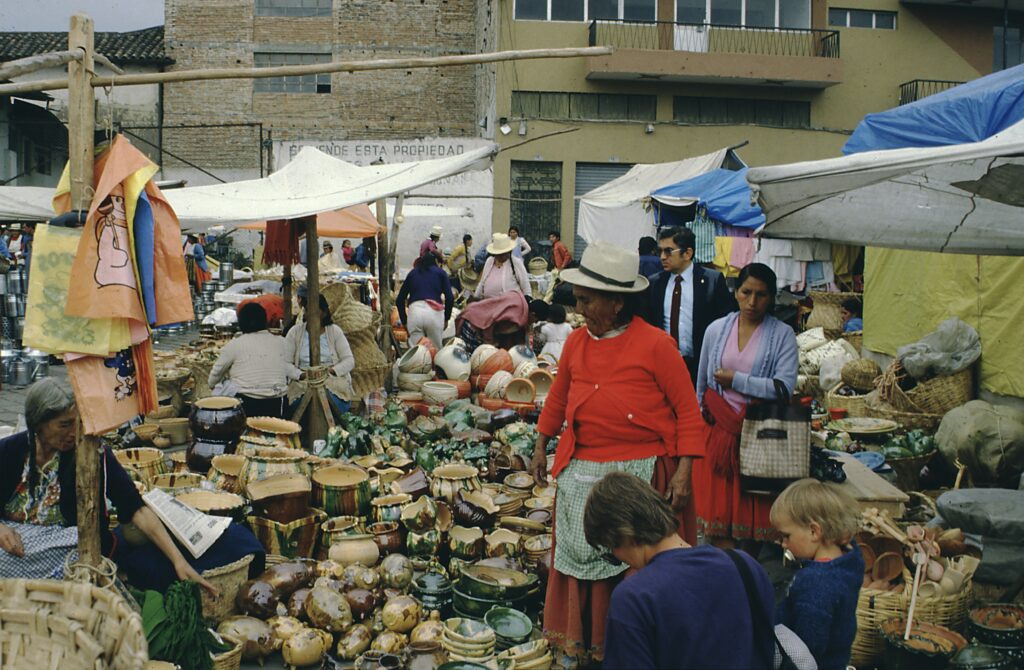
Open-air market in Cuenca, Ecuador. Photo by Hubrtl
And it didn’t end there. The borrower-farmer sold his produce to Coopera at a price closer to the farm-gate price with a little premium added to outbid the middlemen. Before Coopera the poor indigenous farmer would sell a cabbage for, say, 25¢ to the middleman. Yet another broker would sell it to a wholesaler, who re-sold it to the supermercado, the supermarket. By the time it reached the consumer it cost perhaps a dollar. But under the Coopera model, the farmer came to Coopera’s bodega and got about 40¢ for a cabbage, about 15¢ more per head directly to the farmer—no middlemen. He can now afford to send his children and wife to a doctor. To buy his daughter’s school books. He’ll be able to afford more seed, or maybe borrow funds to raise pigs and fowl, and improve his family’s diet.
Most of all, he can repay his loan to Coopera. These smallholders were able to reclaim their honor and dignity through honest, hard work, without being in bondage to the usurious loans charged by the bigger banks. The shackles and curse of poverty were being broken.
There was more… Coopera’s socios received a discount on purchases at the bodega-mercados, and its shops sold under market price, bringing in even non-socios in droves.
Coopera’s success spread throughout the province of Azuay, then expanded to cover Guayas province where the biggest city, Guayaquil, is located.
Regular consumers were happy; the socios were happy; and the gringos were happy too, with better ROI. But the old vested interests were not. They were vexed and perturbed.
Coopera’s head office was situated in San Joaquin near el centro, downtown, but the hub of its activities was in a busy marketplace known as Feria Libre, not far from the old colonial district. This is where diligent Juanito acted as the magnet that attracted gringo dollars. As deposits kept streaming in—and a good 30-40 percent of its deposit base was sourced from the extranjero community—there was practically no competition for Coopera.
They were cornering the extranjero market. Eventually the other banks and cooperatives, along with the landed gentry of Cuenca, became first nervous; then suspicious and, inevitably, toxically jealous. They were losing business and market share. This upstart had to be squashed: they determined to act.
The rich families who controlled the reins of power resorted to dirty work: by hook or by crook they were determined to smear Coopera, to discover—or fabricate—anything necessary to bring down that upstart.
And sure enough, they did find something. Coopera’s general manager, Rodrigo Aucay, had facilitated the “go-around,” a sort of detour to avoid US sanctions imposed on Venezuela. Aucay made Coopera’s rich stash of US currency deposits available to Venezuelan banks, to enabling Venezuelan foreign trade transactions despite the sanctions. It wasn’t fraud, embezzlement or money laundering,3 but busting US sanctions against Venezuela was a problem.
The enemies pounced. In 2013 the news leaked, a bank run occurred, and locals scrambled to withdraw their measly deposits from the main branch. The superintendent of financial institutions, who did not even call for an audit, closed down Coopera. Its assets were seized and sold off—at big discounts—to its competitors.
A lawsuit was filed by the gringos and the rich Cuencano socios. I was in the courtroom as the local judge listened, gazing all the while at her manicured fingernails.
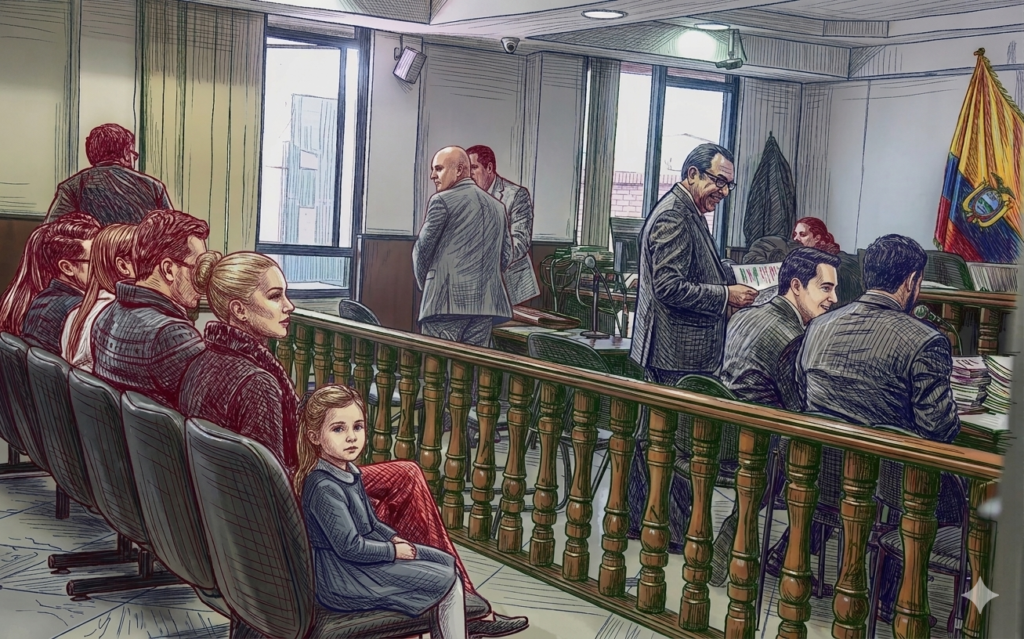
AI Rendering of the Ecuadorian courtroom in which Rodrigo Aucay
awaits a decision on early release.
Ultimately, the populist president dissociated himself from Aucay, who had supported him in previous elections. But the president ordered that the hundred-thousand or so Coopera depositors of up to $1,000 be repaid in full, and the small fry were content. The next tranche, the three thousand depositors up to $50K were paid back also. Those who had put in a little more than that were instructed to wait but eventually they received a compensation of $50K apiece.
And then there was me – me and the 130 other high-net-worth types. We are receiving under $2K annually as a token from whatever assets could be mustered.4 The US consulate was, at best, indifferent.
Still, from this loss, there are lessons learned. Some things really are too good to be true. Sometimes, toxic envy and greed lurk close to what is worthy and good, waiting to bring it down. And sometimes, what starts as noble and honorable can, despite the best intentions, end in disaster.
I believe that from the ruins of what was once Coopera something good will again rise. I believe justice and truth always prevail. And I believe that, from this investment mistake, humility, goodness, and charity towards others will ensue. It was a fiasco, no doubt about it. But there was, and is, much to be learned from the fiasco called Coopera.
About the Author…
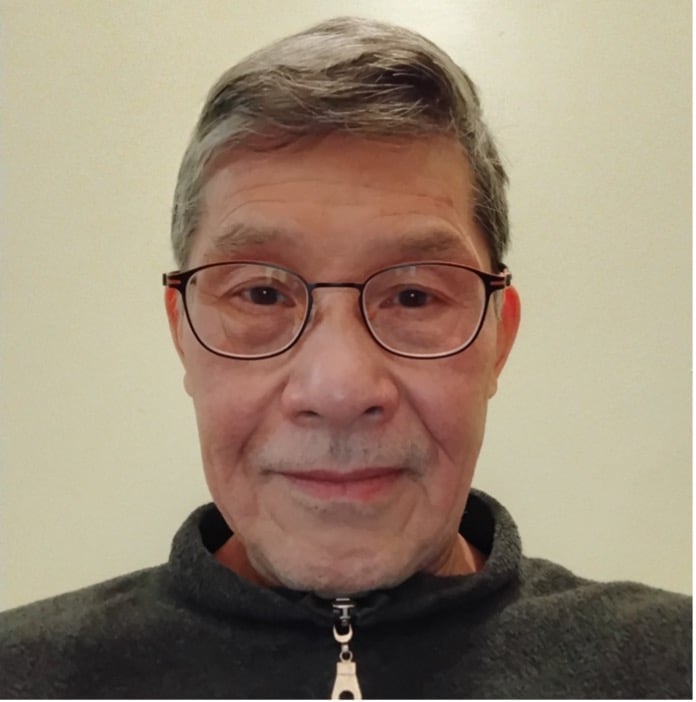
Juanito ‘Sonny’ José is a retired economist and investment professional. He worked for over forty years in the public and private sectors and in various international organizations. He has lived and worked in nine countries across Africa, the Americas, and the Far East, and once climbed 4,500 meters up the active stratovolcano Rucu Pichincha (Ecuador). He is married with two children, resides in Ontario, Canada, and is the proud owner of a French bulldog named Hashi.
- These add iodine to Andean diets generally deficient in that nutrient.
↩︎ - Any of a variety of bivalve mollusks found in warm coastal waters. S. crassisquama, a variety found off the coast of Ecuador has, for thousands of years, played an important role in the rituals, crafts, and even currencies of Andean peoples.
↩︎ - In fact, Aucay and his CFO were prosecuted, convicted, and jailed on charges of both money laundering and embezzlement - Editor
↩︎ - After failing to obtain appropriate recompensation from the local courts, our Ecuadorian lawyer submitted an appeal to an international body to address the losses and grievance of the remaining investors. - Author ↩︎
Juanity ‘Sonny’ José í