
Andrew Hingston
Guest Writer
Sooner or later who we are comes to the surface. It follows us like a shadow, and like a shadow it shows most clearly when we are out in the bright sunlight.
I’ve been volunteering in a soup kitchen in Poznań, Poland, every Saturday afternoon since 14 June. Yesterday was my seventh time and it’s been great. I’ve met many new people.
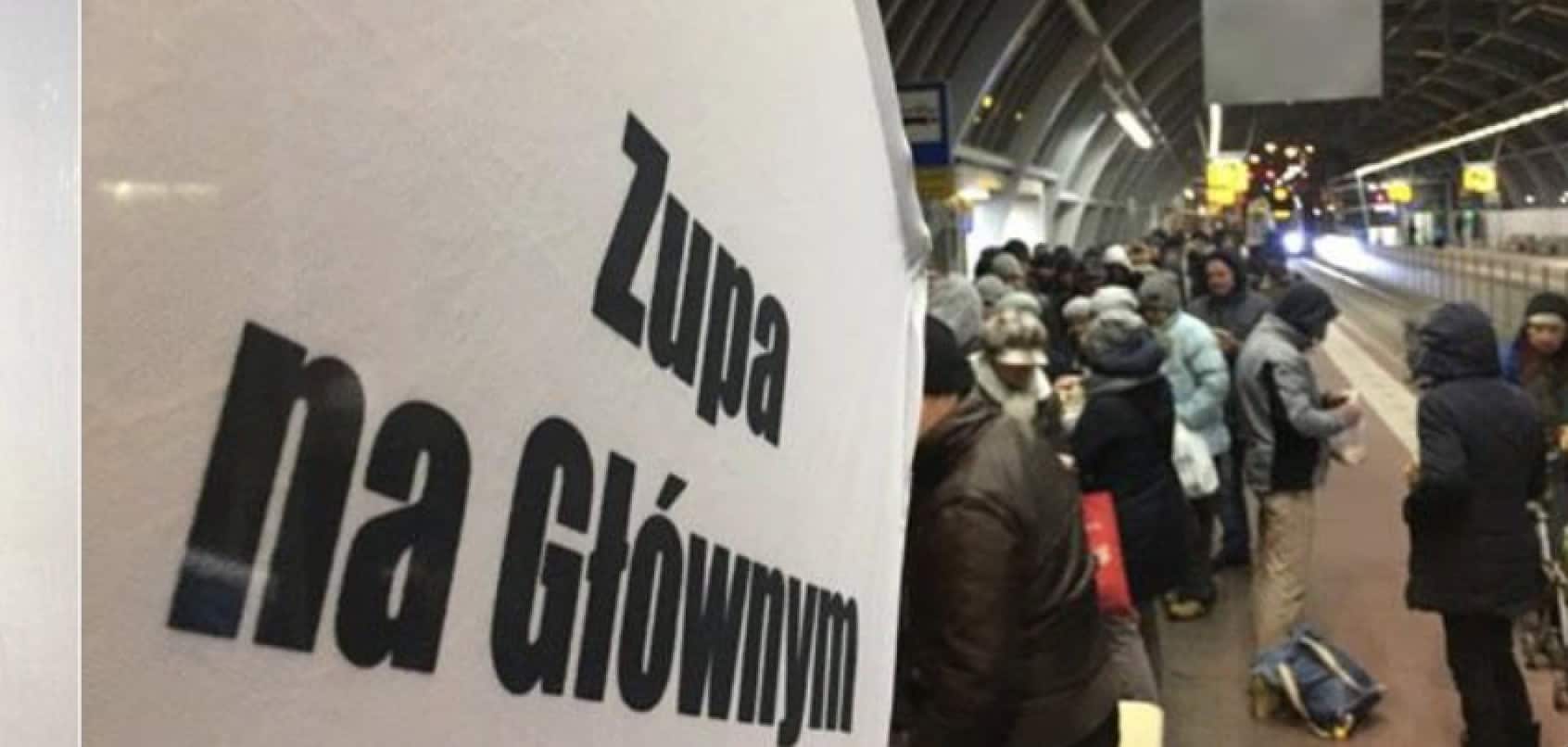
Each week it seems a mostly different cadre of about 8 to 10 volunteers shows up to supplement the four or five regulars.
Usually, they come because of an arrangement between the kitchen, Zupa na Głownum (Soup at the Station), and the company they work for. For example, one week McKinsey & Company (which has a large back-office presence in Poznań) sent a group. Another time, Franklin-Templeton (ditto) sent a cadre. Other times it’s been a local software or logistics company. Those cadres usually show up wearing company t-shirts that say “Volunteer Team” in large letters on the back. They are cheerful, energetic, helpful, and seem entirely sincere – I haven’t gotten the impression they’re there just to impress their managers or their HR people. Because they are young and educated, they usually include a couple of people who not only know English fairly well but who enjoy using it.
Among these company cadres, most participants are in their twenties or thirties, and there’s an even balance of men and women. A few people bring children, though they usually leave after an hour or two. There isn’t enough for young children to do safely; they become bored and peevish. Fortunately, there is a wonderful, large park with a wonderful, large playground filled with things to climb on directly across the street. I hope the parents take advantage of it. But people being the way they are, I imagine most of them don’t even see the park and simply get in their cars and go home.
The program at the soup kitchen follows a pattern so settled and familiar that, after the first time, one begins to be an old hand, to know where things are kept, and in what order events should progress.
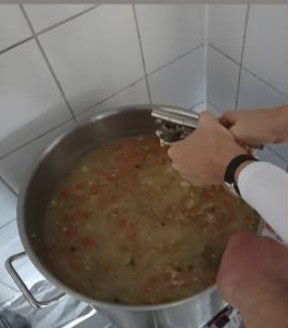
Beginning at one o’clock, at a table that is about three and a half meters long and is covered with several layers of patterned oilcloth and surrounded by plastic chairs, eight or ten of the volunteers start peeling carrots. Carrots are always first, and
there are always carrots no matter what the soup is destined to become. Other vegetables follow. Almost always onions or leeks. Sometimes celeriac, often pietruszhka – parsley root – which is common in Central and Eastern European cooking though rare elsewhere. Near the end of the first hour comes potatoes. Lots of them. Always.
Potatoes are a religion in western Poland, which is sometimes called Pyrlandia – a nickname meaning ‘potato country’ from the word pyra, which means potato in the west Polish dialect. People in Poznań also say ziemniaki (Polish for potato) and sometimes the German kartoffel. Everyone knows all three words.
When I say that potatoes are a kind of religion, I don’t mean to imply that they are accorded much respect. It’s more that they are simply an unquestioned part of everyday life, like going to Mass. A day without potatoes is, for many people, unthinkable. In the supermarkets there are only ever two types: young and old whereas in England one finds Maris Piper and King Edward and three or more other varieties. In Poland, it’s just young and old.
In June the young ones are small and almost sweet, while the old ones are comparatively larger and, for some reason, always covered in a layer of dirt. By now, in August, the young ones are larger and the old ones seem tired, deflated, and are often wrinkled, though still covered in dirt. I have yet to find a Polish potato that results in a truly good roasted potato as the English make them. Too bad: I like roasted potatoes. I sometimes cook them, but I’m never very satisfied.
While the vegetables are being peeled, in an adjacent room, meat broth is being prepared. Nearly all Polish soups traditionally contain meat. So far the broth (soup base) is always based on pork or chicken. Beef and fish are too expensive. The chief cook and founder of the charity is a small,
round woman in her early to mid sixties, who doesn’t speak much and almost never smiles or laughs. She wears her hair tightly pulled back and is always festooned in a too-big apron that is never clean, even at the start of the day. She seems perpetually tired, but in fact has more stamina than any two of the rest of us. Her name is Fioletta, though she’s called Lhola.
Her husband is her complement. He’s huge, though also round, and very jovial. He speaks good English. His name is Jacek. He doesn’t do much except watch over things and drive the van to and from the site where the food is served. But if something goes wrong, everyone looks to him to fix it, and he usually does so, quickly and without complaining. He’s a “no drama” sort. Always smiling. Nie ma problemu (no problem).
After the vegetables are peeled, they are washed, then chopped, always into cubes about two centimetres1 square. In the end there are several large basins of cut vegetables, and a couple of basins of cooked meat. Sometimes the meat is boiled, sometimes browned in skillets, sometimes
roasted in an oven. I don’t know where the oven is. When roast meat is called for it seems to arrive already roasted. In any case, once the meat is cooked, it too is cut into cubes about the same size as the vegetables. Lola labours over two huge cauldrons that sit atop two large gas rings. She has a huge wooden paddle that she uses to stir the soup.
I estimate that we make about 100 litres of soup each Saturday. When it is done, it’s transferred from the cauldrons to two very big insulated containers of a sort that I imagine is widely used by military field commissaries. It keeps hot for hours. We generally finish making the soup before four; we don’t serve it until five-thirty.
My favourite soup that the kitchen makes is Ogórkowa – sour pickle soup. It is a work of genius, a perfect balance of flavours and textures, just slightly sour in a very refreshing way. The most famous Polish soup is Żurek, also slightly sour, but made so by the use of fermented rye flour. Żurek takes a long time to prepare and is comparatively expensive. It contains meat, both fresh and smoked; hard-cooked eggs; and two or three types of sausage. It is customarily served on Easter, but is available all year long in restaurants committed to serving traditional Polish food.
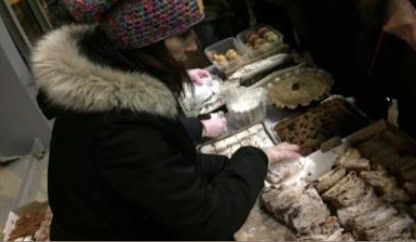
As well as soup, we make sandwiches, at least 200 of them every Saturday. They are invariably made with a sort of basic Polish bread called baltańska that contains both wheat and rye flour. It’s cheap, soft, not very flavourful, and full of air – though a few bakeries make starypolska (old Polish) versions that give one a sense of what it can be like if properly made with enough rising time and good ingredients. At the Soup Kitchen, we use the inexpensive stuff – I think it is donated by a large commercial bakery. Lhola is very good at twisting arms and getting donations of the things she needs.
Sandwiches are made about forty at a time by laying bread slices on the table (the oilcloth has been wiped clean after preparing the vegetables) and spreading it with a too-thick layer of margarine. Then meat (usually sliced, very fatty, pork, but sometimes a sort of meat spread like ‘deviled’ ham), then sliced cucumber, sliced radish, and arugula. (Poles, having discovered this Italian salad-green about twenty years ago, now put it on everything.)
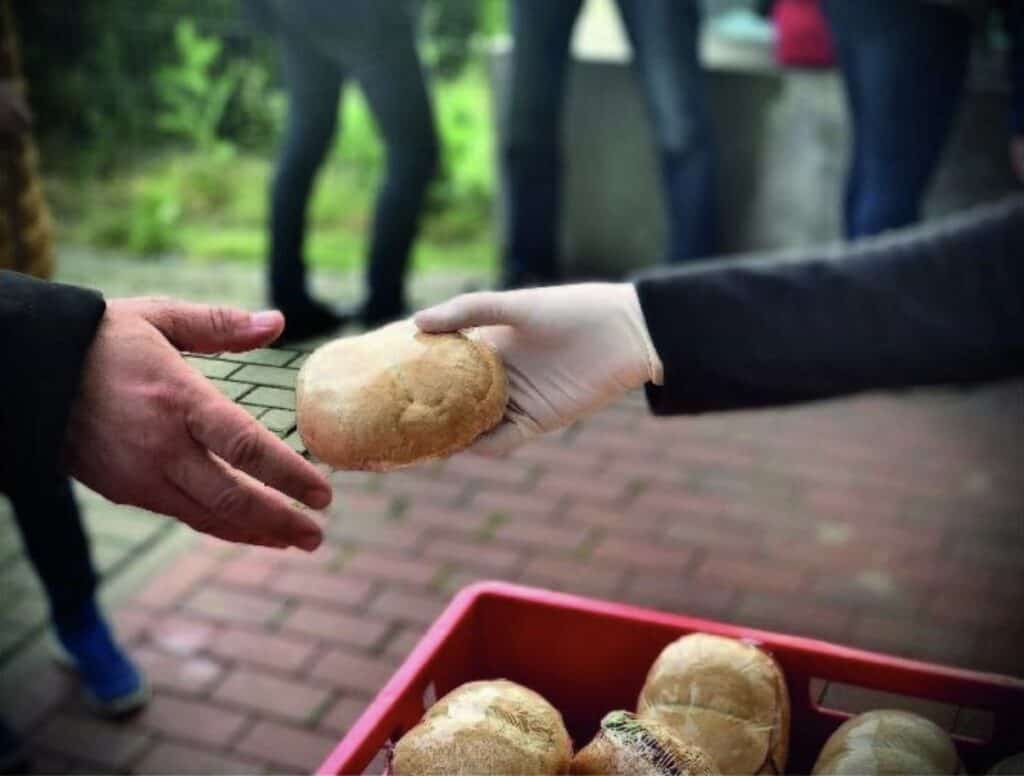
Individual sandwiches are put in plastic sandwich bags that are then sealed with a gizmo that frequently jams, provoking equal
amounts of laughing and swearing. They are then stacked in a couple of shipping crates. It’s a very jolly assembly line and a sort of Santa’s Workshop atmosphere prevails.
There are few luxuries, but one of them is an outstanding automatic Swiss espresso maker that turns out a first-rate cappuccino. Everyone is welcome to as many coffees as they need to get through their chores. I usually have due cappucinni in an afternoon. The only other luxury is a stereo system. If I could figure out how to break it without being found out, I would. The music that is chosen is always either pop or hip-hop. Fortunately, it is not played loudly and I have learned to ignore it.
One thing missing is adequate ventilation. A hundred litres of soup cooking for roughly three hours produces an atmosphere that approximates market day in Kampala2 in August. I have no
experience of Kampala, but friend has told of needing six showers a day and finding it hard to breathe because the air is so thick and heavy.
By the time we’ve finished making the soup, everyone who has stayed that long is glistening with sweat. At that point we wipe down the table again and have a communal lunch of soup and the ends of the bread that were too small for sandwiches. It is always tasty and sometimes exceptionally good. It is hearty, not fine, but that pretty much describes all Polish food. Though
many dishes are delicious, and most can be satisfying, I can only think of one that has any claim to finesse. It is the clear form of barscht (borscht) that is served only at Christmas, just once a year. It takes two or three days to make from scratch but it is worth it: it is wonderful.
By four-thirty we are all done with cooking and feeding ourselves. There is then about half an hour during which we clean up or relax or both. There is one small energetic man named Przemek, about forty-five and much shorter than I am, who loves to wash dishes. One must be very much favoured to be allowed to help him. The rest of us relax or take a short walk or have a coffee. A couple of people make enough coffee and tea for 200 people and transfer it to four large thermos
jugs, also of a sort that one imagines being used by the military on manoeuvres.
At about five we begin packing the van, a standard sort of white delivery van that is just exactly large enough for all the stuff. Folding tables. Portable thermoses for soup (huge) and coffee and tea (large). Packing crates of sandwiches. Utensils. Rolls of kitchen towel. Portable folding plastic bins for trash. Also boxes of latex gloves (for those serving food) along with boxes of plastic bowls and plastic spoons. We try to use things that can be recycled, but whether they actually are is an open question. There are also a pair of large, bright red canvas bags that together constitute a very well-stocked first-aid kit.
Each week an emergency-room doctor joins us at the serving site and, as well as she can, takes care of those who need it. Lots of cuts, scratches, bruises, insect bites and, this time of year, sunburn. Judging from the meds she hands out, lots of constipation and diarrhoea. Lots and lots of headaches. Also stomach bugs, oedima, arthritis, various aches and pains. And complaints. The doctor ends up being a therapist as well as a triage specialist.
The site where we serve the food is a paved lot adjacent to a tram stop that is itself adjacent to the so-called Western Train Station. It is in a downtrodden part of town called Łazarz
(Lazarus). In Poznań, Lazarus has not yet been wakened from the dead. The area where we serve belongs to the railroad company and is enclosed with a security fence, sealed off with a reinforced gate that is locked. It is supposed to be unlocked when we arrive, but twice it has not been. Jacek, the fixer, calls the police station next to the train station. Someone comes out and, rather grumpily, opens the gate. We then quickly set up and start serving. It all goes exceptionally smoothly.
Who comes? By the time we get to the site at five-thirty there is a sort of queue of well over a hundred. It is a Polish queue, not an English one, which means it more closely resembles a throng than a queue. But, inevitably, people get served one at a time, though quite quickly. All seven times I’ve helped at the site, I’ve never witnessed a fight of any kind, and yesterday was the first time I heard raised voices. One man was angry that a fellow in a wheelchair was allowed to jump the queue – such as it was – by a few places. In truth, it wasn’t necessary, and the show of favouritism wasn’t helpful as it made everyone feel a bit more stressed than was necessary.
There are generally about 12 to 15 men for every woman. I have never seen young children. I’ve only noticed two groups that appeared to be families – both times, the children involved were teenagers. No one seems obviously drunk or stoned, though there are a couple of men who come each week who are always pretty loopy. Is it intoxicants, or cumulative concussions, or mental illness? I don’t know but no one seems to mind. No one is censorious. Jacek makes a point of greeting the loopy ones as old friends and they appreciate it. Ages range from roughly twenty to about eighty, with the majority
between forty-five and sixty-five.
By six-fifteen, we are all done. Everyone one has had a sandwich and a first helping of soup. All those who want it get a second helping of soup. People are grateful and show it without being obsequious or fawning.
At that point I say goodbye to the team and walk to a nearby tram stop. I usually head home, but lately I have been meeting my son Chris at various pizzerias each week for our ‘pizza night.’ I keep trying to persuade him to come and help me at the soup kitchen but each time he says, “I don’t think so this time, Daddy. Maybe next time.” And so I keep asking. I think he is slowly starting to consider it.
So what was I writing about when I spoke ominously of shadows in the first paragraph? I was writing about myself. I was writing about my tendency to think I know better than others, have better ideas, or a better plan. I was writing about my snobbery – not toward the people we serve but rather those I serve with. I was writing about my apartness.
Yesterday, for the first time, I felt as though I would rather be somewhere else, doing something else, with
someone else. By the end of it, I was actually feeling just a tiny bit angry. I am not sure why. But I will keep thinking about it.
But for the next three Saturdays, at least, I will not be able to study this as I won’t be there. I will, in fact, be somewhere else, with someone else, doing something else. I will be in Tuscany seeing one who was once a very close friend. We became disconnected. No one wanted it to happen, it just did, back in the pre-Internet, pre-cell phone days. I will be soaking up friendship, soaking up art, architecture, food, and absolutely soaking up wine.
When I return to Poland, to Poznań, I will again help at the kitchen. It is good for me. It is grounding. It is soup.
[Andrew Hingston lives, and writes, in Poznań, Poland]