
“By 11:59pm on 31st March, 2026, this room — my home office — will be
decluttered, neat and orderly.”
– Robert Munafo
That was my declaration, made to the Atlas[1] leadership team, on the 14th of January this year. But I may as well have been declaring:
I hold these truths to be self-evident, that I have the inalienable Rights to Mental Clarity and uniformly High Awareness. That to secure these rights, Self-Governance and Discipline must be marshalled, That wherever a Discipline fails to serve or its Execution falters, it is my Responsibility and Privilege to institute new Disciplines and Practices. Leadership, indeed, will reveal the Courage, Authenticity, and Exceptional nature that I bring to the exercise of my Power to manifest full Self-Transformation…
You get the idea. I could go on, having lived in John Hancock’s old neighborhood for so many years.
Triage was initiated immediately. It was an archeological sort of work, sifting piles of clutter, clearing the way to access more piles, and more, and eventually working down to the stuff I hadn’t seen in years — all fairly typical and familiar work for me.
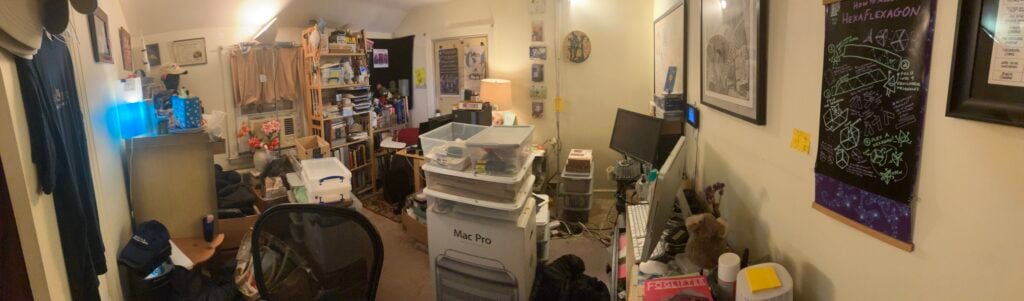
The ‘Before.’ Photo by Robert Munafo.
Meanwhile I made paper blueprints that were proved accurate to within ±5 milimeters, correctly predicting the need for baseboard to be removed in order to permit newly purchased cabinets to fit symmetrically.
Yet far more importantly, I thought deeply about what had created the problem in the first place. Very clearly, it stemmed both from an addiction and from a set of poor habits:
• My attachment to the mental stimulus of seeing literally hundreds of my familiar objects, all cherished or valued things
• Disciplined procrastination of the tasks of neatening, organising, and prioritizing the urgent versus the merely important
I chose to attack the source of the issue by revolutionizing my approach. I had growing ambitions, and the project would require teardown, assembly, and reconstruction, with concomitant Gantt charts, the ordering of new furniture, and weekly status updates to my teams — including panoramic photos.
In the midst of all this I had plans, already arranged and ticketed, to travel round the world.
Yes, right in the middle of this reconstruction I was headed to a distant and unfamiliar nation, a Communist country no less. Cue transformational crisis No. 1.
The trip, which I have written about previously (Tết à Tête: A Motorbike Ride in Vietnam, Legacy Magazine, March 2026) allowed me to work through a bunch of old shit, and to experience the unsung virtues of leaning in.
My takeaways from that adventure include a cathartic understanding of the trauma and guilt I still carried from the Vietnam war, prosecuted six decades earlier by my parents’ generation; the realization that a man I hadn’t seen in fifteen years remained as good a friend, and as committed a fellow man, as I had expected from my year-or-so with him on his first Men’s team; that my global Mission and Vision are as pertinent to this culture as to my own; and that nothing helps a months-long, intensive, life changing project so much as twenty five days of complete separation from the task. I had nothing to work on but context — and, of course, loftier goals.
I adopted the Life of Holism and Completeness: freely discussing my Spirituality, MDI, Colleagues, Friends, and Family with each other.
During this odyssey, having also spent a week on spiritual pilgrimage in Japan, I flew to a maths conference in San Francisco. A few days more with the men of MDI’s 510 Tribe, and then on to attending double team meetings. When at last I returned home, I stepped into a space I didn’t recognise.
I had occupied this room during nine long months in chemotherapy and, in all, stuff had been accumulating in there for nine years. The space had accrued reminders of a lifetime of memories, recollections that, in fact, lived only in me, not in these things. The objects literally piled up on the floor were representing these memories, which were piled, just as haphazardly, within me, waiting for the slightest trigger.
The sense of risk and disruption served to lower the perceived risks of other great changes. I had, for example, long been averse to getting cataract surgery, to having my eyes “fixed.” It’s a procedure that carries a slight risk of severe vision loss, yet was necessary if I ever intended to drive a car again.
The concept for my physical space had advanced substantially, and the physical configuration became more ambitious. A laboratory: all white, with geodesically configured LED ceiling lights; and with enough cupboards and drawers to put away and organize anything and everything I would actually need. It would be modular, for ease of reconfiguration; and it would include a geometric, coloured labeling system. Finally, it would conform to the six Rules of Habit I was learning to apply, thanks to our Health, Fitness, and Longevity Club.
Make it obvious • Make it satisfying • Make it fun
Make it simple • Tie a new habit to an existing habit
If you miss a day, don’t let it happen again.
On my return from travel, entering a space that was soon to be as expansive, as intentional, and as soothing as the Japanese monastery I had just returned from, I found a resonance, an internal consonance, a new internal organization to match the nascent changes in my office. Just a few days after returning home, I committed to the long-avoided eye procedure.
Unpacking from the five-act odyssey took another day from my now-packed schedule. The deadline was looming and I still needed to assemble furniture: five rolling cabinets at three hours apiece, making for a manic weekend and two days of sleep recovery. Jet lag was, somehow, the least of my troubles.
I set up enough bookshelves to unite my 960-title library. And while in Japan I had worked out how to connect my desktop devices to a wall-mounted TV with no wireless tech, no touching the floor, or obstructing the horizontal movements of chairs, the desk, the eight new cabinets, or me.
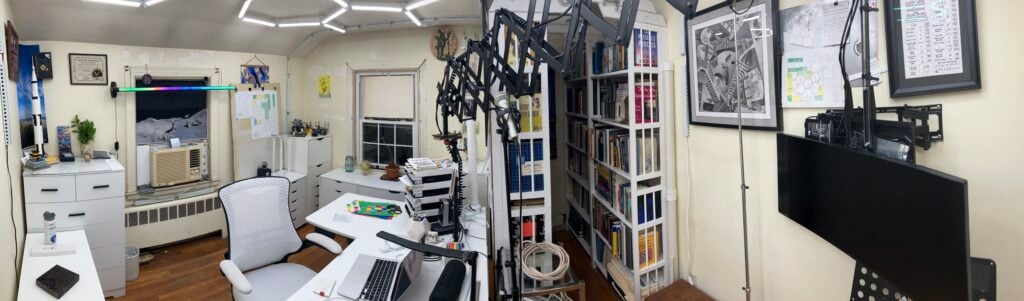
The ‘After.’ Photo by Robert Munafo.
Indeed, I moved every Thing into a Pile in the Centre of my Home, then I made a Home for each Thing,and now this Space is re-filled whilst remaining simple and orderly. My World is in order — as I have outer Peace, so I have inner Peace, while everything is experienced as being remembered in the Moment, and perfect just as it occurs. In an uncluttered World, the brilliant Light of my total Conscious Awareness illuminates All,
and with a minimum of Shadow.
All was done by March 31, with nothing left but ‘the Great Reveal’ on April 1.
My goals were far exceeded and yet, soon after, when filling the bookshelves, I found the paper — a report and some overhead transparencies — from my high school final project. I had presented these at the New England semifinals of a research competition and, with them in my hand, I broke down crying. I still felt great embarrassment from the hubris I exhibited after giving that talk.
And again, while playing randomly selected music while I worked, songs from the 70s and 80s were making me cry. It was long before I could identify the reasons, but it seemed to be from the basic fact of a break from the past; the associated (albeit irrational) sense of loss. My cluttered living style, long familiar, was gone, and a part of me felt unmoored. Though my Men’s Teams aided me through these feelings, they were nonetheless profound.
But the other side of the coin soon made itself felt as well.
On daily walks I discovered that I had achieved heightened awareness. I now knew when it was safe to cross the busy street without turning to look (though I still peeked to be sure.) I was suddenly aware of the soft noise of distant cars behind me, without needing to listen for it.
In general, on a daily basis, I was more readily picking up on people’s emotions and thoughts via their facial expressions, a skill I had admired in others. I was able to use my faculties of awareness and thought more fully and for far longer periods without the mental exhaustion I would have felt in the past.
Finally, I will observe that transformation and change in my external life caused an internal rise to greatness that I had never thought possible. And there is surely much more to come. And so —
I am Munafo — and I am complete.
About the Author

Robert Munafo is a polymath and student of the human condition based in Rhode Island.
He maintains himself with the help of the knowledge and techniques described at mrob.com/men
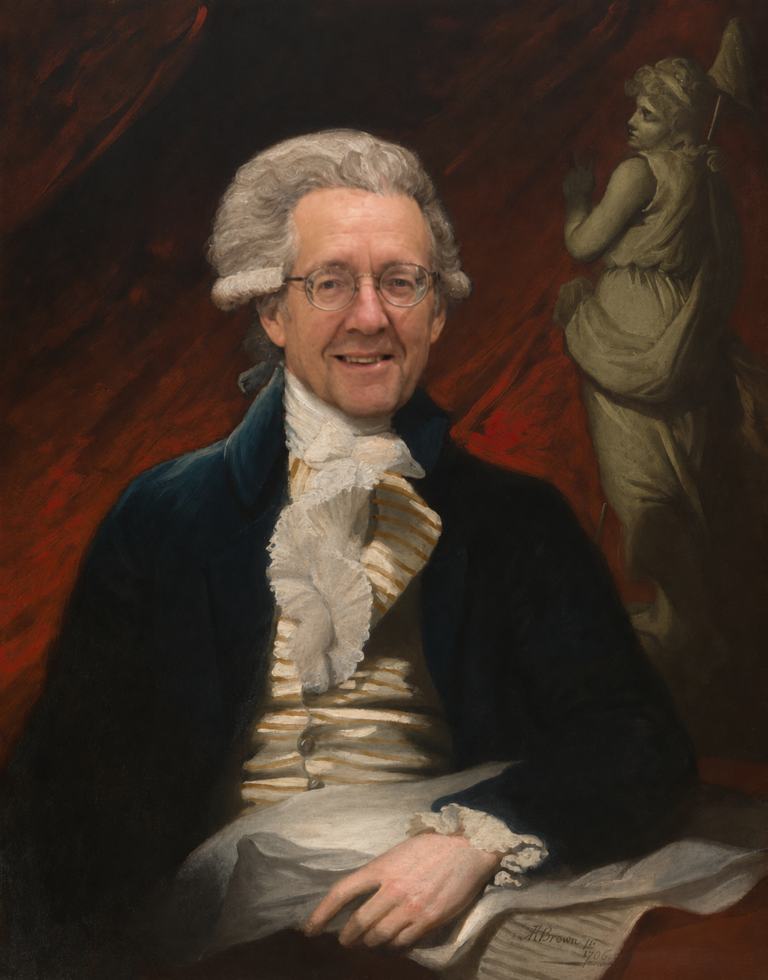
A Word on the Fronispiece...
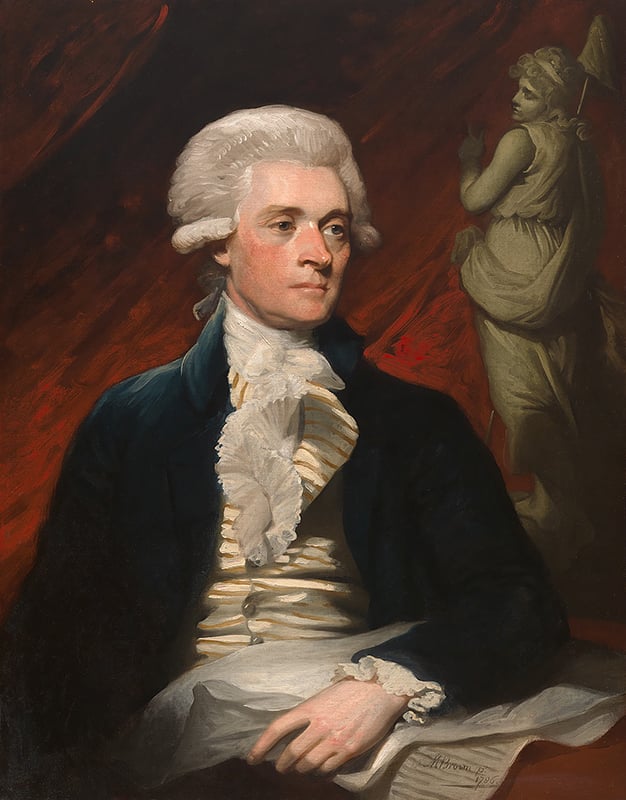
The frontispiece was adapted from this portrait of Thomas Jefferson
using ChatGPT software. Painting by Mather Brown,
Oil on Canvas (1786). National Portrait Gallery.