


“I’ve Had It!” I cried.
That was my exclamation back in 2007. It was a cry of financial despair.
I’d had it with mutual funds; with company-sponsored retirement plans; with day-trading, hot tips from my broke brother-in-law, and with calls from junior stockbrokers in some bullpen selling whatever trash was on their desk.
I also knew that neither my family, nor my employer—nor even my government— were going to get me to a livable retirement.
Therefore, I started learning about different types of investments. . . but not from the people selling them.

Photo by Thomas de Luze
Greg Habstritt’s, The RRSP Secret[2] clued me in to the fact that mutual-fund managers get paid whether I gain or lose. The buyer takes all the risk, puts in all the money, and gets a taste of the reward — or the penalty.
The broker puts in no money, takes no risk, and gets a guaranteed reward right off the top. If the fund drops, I don’t get a partial refund of my fees. I get a lecture on “buy the dip”.[1]
But guess who this benefits if I do?
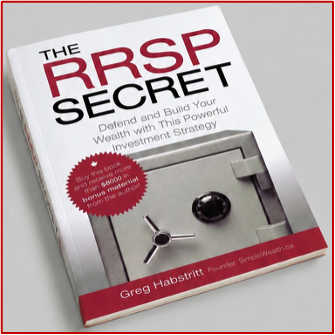
Photo by Thomas de Luze
Company-sponsored retirement plans are another trap. The “But it’s FREE MONEY!” crowd doesn’t know that long-term, self-managed investments can make a better return than an employer co-funded plan because of the fees.
I did the math and if, after fees, I can get a return that is 4.6% above the employer-matched pension plan over a 25-year period, then even with the employer match factored in, I can retire with more money than the company plan.

The random call from the junior broker? Robert Kiyosaki reminded me that they’re called “brokers” because “they’re “broker than me.” Do I really want to take stock buy and sell signals from someone who hasn’t gotten rich from those signals themselves?
Tony Robbins taught me to find, instead, someone who had done what I wanted to do, then to do whatever they did.
His book Unshakeable talks about the frequency of market crashes and, once I knew these were not only expected but regular, I could plan for them instead of panic-selling when they happened.
At age forty, I wanted to build a retirement plan that made sense; one that would have me out of the working world by sixty. That gave me twenty years to work with.
I read Robert Kiyosaki’s book, “Rich Dad Poor Dad”[3] and applied the lessons.
Then, I read the rest of his books. His in-person weekend course was also very helpful. Best $500 I had spent on investing at that point in my life.
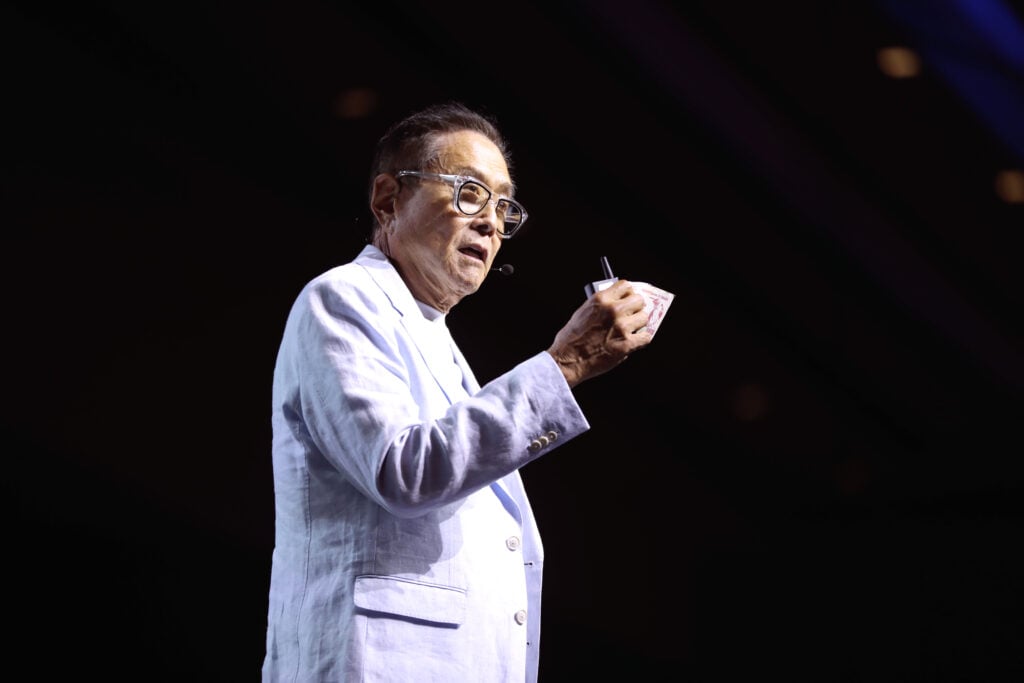
Robert Kiyosaki
I found a realtor who understood the concepts Kiyosaki taught in Rich Dad Poor Dad and worked with him. Other realtors, who didn’t understand those concepts, told me what I was looking for didn’t exist.
My final job was as a tester for a company building scientific-analysis software. One of the perks was a daily copy of the Globe & Mail in the lunchroom. While the other men fought over the sports section, I went after the business news. The paper ran a stock-picker series that sliced and diced the market a different way each day. It showed which stocks made that day’s top stock list, and the performance of that group based on a 10-year back test.
Stock ticker in Glasgow, Scotland. Photo by Tyler Easton.
After months of watching I noticed certain companies kept popping up no matter how the market was filtered. When they ran a filter describing good-paying dividend stocks, they were all there. Now, I had my stock-picking strategy, which was:
1. I would trade domestic stocks only
2. Every instrument must have an annual dividend yield of >4%
3. The average annual dividend increase must have been > 4% over the last five years
4. No dividend payments had been missed over the previous five years
5. The stock’s price had risen steadily over the prior 5 years and
6. The payout ratio was 80% or less
Of the >4,300 stocks listed on the Toronto Stock Exchange, fewer than one in two hundred met all these criteria.
I continued with that system, but then I learned about investing in a Tax Free Savings Account. The TFSA is a Canadian investing tool similar to a Roth IRA in the U.S. It holds investments of almost any kind and the funds are not taxed when withdrawn. But one advantage over the Roth is that, in a TFSA, the contribution room is cumulative and doesn’t disappear if unused.
I did the calculations and found that a thirty-four year old Canadian, who begins investing today, can contribute $1,000 a month to their TFSA for twenty years and never hit the maximum contribution limit.

Photo by Eugenia Clara.
The best strategy, as espoused by Shark Tank’s Kevin O’leary,[4] was to buy only good-paying dividend stocks and never spend the capital, only the dividends. So I bought some within my TFSA.
The next step was to calculate the total amount of cash I’d need working for me in order to retire. The tools were provided by blogger Mr. Money Moustache[5] but it was only grade-5 math: add up all my expenses for the year; multiply by 1.3 to account for income taxes, divide by the average percentage return on my investments, and that rendered the lump-sum capital I’d need working for me in order to replace my wages.
Another method is to assume my current job income exactly matches my expenses, and to use my annual gross salary figure instead of adding up all my expenses.
This isn’t just theory, it works: Mr. Money Moustache retired within nine years of leaving university.
Almost sixty percent of Canadians don’t believe they’ll ever be able to retire. Not at 65, nor at 75, not ever. My goal was to be out in twenty years.
In the end, it took sixteen.

Photo by Shubham Dahge
It all worked. The whole structure got me where I wanted to go: retirement only sixteen years after beginning the process. I’d found the exit from the Rat Race and It wasn’t locked.
I was done with taking traditional financial advice from broke people, but it took me a long time to learn all this stuff. I stepped in a lot of gopher holes and spent a lot of money making stupid mistakes.
The money I lost paid for the equivalent of four university degrees, and that’s how I think about it: I consider it tuition.
Indeed, when the process began, I’d truly had it! When it was over, I had it all. I now spend my days doing what I want, when I want, where I want, and with whom I want, for as long as I want. That’s financial freedom.
Now, I help others who have had it! find financial freedom for themselves.
References:
[1] “Buy the dip” is an investment strategy for purchasing a stock once it has fallen in value or “at a discount.” If the stock rises, higher gains are made. The risk is that the stock continues to tumble, leading to even larger loss.
[2] Greg Habstritt, The RRSP Secret: Defend and Build Your Wealth with This Powerful Investment Strategy (Mississauga, ON: John Wiley & Sons Canada, 2010)
[3] Robert T. Kiyosaki, Rich Dad Poor Dad: What the Rich Teach Their Kids About Money—That the Poor and Middle Class Do Not! (Scottsdale, AZ: Plata Publishing, 2017).
[4]Terrence Thomas Kevin O’Leary is a Canadian businessman and television personality, best known for his appearances on the American Broadcasting Company’s hit T.V. series, Shark Tank
[5]Pseudonym of the Canadian-born financial blogger Peter Adeney.
About the Author:

Jerry Penner is a retired computer geek who spent years struggling with traditional market advice before finding his own path to financial independence. He is also a fire and life safety (F.I.R.E.) educator and a member of Mentor, Discover, Inspire. He shares free financial resources for men who want to take control of their financial futures at: www.jerrypenner.com