

I was getting ready to participate in my college’s Outward Bound[1] program. It was 1971 and I was an incoming freshman at a place called Vanguard School.
The program was designed to be difficult, to push students to uncomfortable places, and to provide them with some tools to adapt better to life on campus.
As part of our preparation, we were tasked with reading Man’s Search for Meaning,[2] Viktor Frankl’s account of how he and others survived Nazi concentration camps by searching for meaning in their suffering. Nothing we would do in our course could come close to what those prisoners endured, but it showed what was possible when one had better mental and spiritual tools in one’s toolbox.

Viktor Frankl in 1965. Photo by Professor Dr. Franz Vesely
We Homo Sapiens have long been searching for such tools, and there are examples aplenty. John Milton first coined the term silver lining in his 1634 play Comus wherein he wrote,
Was I deceived, or did a sable cloud
turn forth her silver lining on the night?
Most of us have heard “behind every black cloud there’s a silver lining” so often it’s become a trope. “Yeah, yeah, I know,” one thinks, “look for the silver lining. Whatever.”

Photo by Wolfgang Hasselmann
In the evangelical Christian home of my boyhood there was plenty of help from the Bible. Romans 8:28 notes that “we know that all things work together for good to them that love God, to them who are called according to his purpose.” That chestnut got a lot of use whenever talk turned to why my non-smoker father died of lung cancer when my brother and I were less than six years old.
And, of course, there’s Job: old luckless Job, subjected to all manner of tortures, saying, “Though He slay me, yet will I trust him.”[3]
Godspell,[4] the Broadway musical even had a song, All for the Best,[5] referring to Job’s travails.
Temples are graying and teeth are decaying
And creditors weighing your purse
Your mood and your robe are both a deep blue
You’d bet that Job had nothing on you
Don’t forget that when you go to heaven you’ll be blessed.
Yes, it’s all for the best.
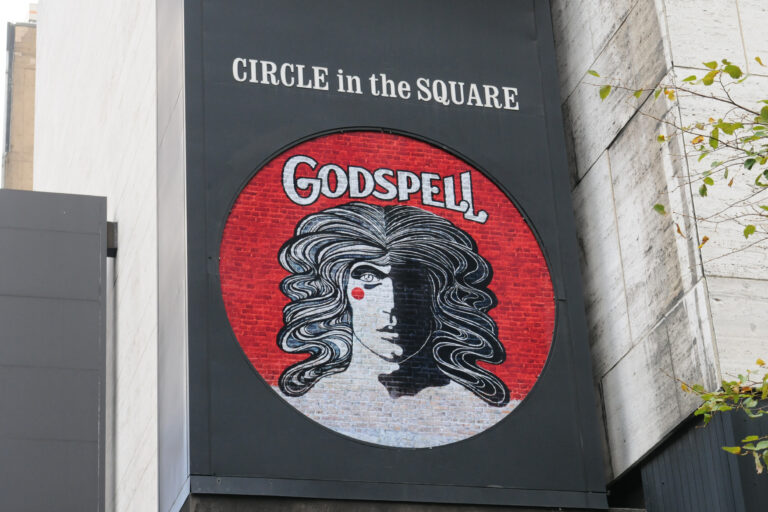
Circle in the Square Theatre marquee, Godspell, October 22, 2011. Photo credited to Broadway Tour.
Yes, it’s all for the best, no matter how bad shit gets. Someday you’ll be blessed.
While we’re on the Bible, let’s not forget Monty Python’s Life of Brian[6] and the classic Always Look on the Bright Side of Life.[7]
If life seems jolly rotten,
There’s something you’ve forgotten,
And that’s to laugh and smile and dance and sing.
When you’re feeling in the dumps,
Don’t be silly chumps.
Just purse your lips and whistle, that’s the thing.
And… Always look on the bright side of life.
Look on the bright side. It’s all for the best. All things work together for good, there’s a silver lining, and look for meaning in suffering. All familiar, all good ideas.
You could make your own list but, more than likely, asking “What’s great about this?” wouldn’t be on it.
When I first heard the that question, that idea, years ago, I held it at arm’s length. I did so even though a wise man, one whom I respected, had shared it. He had, he said, once asked it of the men in his circle, right after one of them had died.
“Yeah,” I thought, “I don’t believe I’ll ever ask anyone that.” And yet, like all such big ideas, once heard, I could not unhear it.
Still, I was pretty sure I’d never live into answering what’s great about my own dad’s early death. Or what’s great about cancer in a child? Come on, be serious.
In its own way though, the question is aspirational. Like a moonshot, a Hail Mary. The word “great” just hangs out there, begging you to push back. It’s not what’s okay about this? or what’s not so bad about this?
I dare you to ask, it says. The word “great” implies celebration somehow. Like “Oh, man, this is great. Yeehaw!” It could have been another word like fantastic or wonderful or some other synonym, but it isn’t. “Great.” It’s a blunt instrument, a wrecking ball, demanding that you do a seemingly impossible thing.

Photo by Bradley P. Johnson.
I mean, what’s great about this? Go fuck yourself. Why would anyone ask such a thing? Why, indeed.
Then it started to take root, like a time-release deal. As Rilke told the young poet, “Live the questions now. Perhaps then, someday far in the future, you will gradually, without even noticing it, live your way into the answer.”[8]
It’s an outrageous question really, way more assertive and in-your-face than “silver lining,” much more deserving of a “fuck you” in response. Like telling a truly offensive joke that crosses the line. It’s not funny like Python.
Photo by Olah Renáta Adrienn
Go ahead, ask it… then duck, as if you’d thrown a hand grenade. It catapults you right to the edge, where all the contradictions are, the gray areas. “No fucking around here,” the sign warns, “this is the deep end.” It just feels wrong and against our nature to ask such a stupid question, especially in a time of great sorrow or grief.
This is Exhibit A in radical gratitude, like a two-by-four upside the head. It’s not a statement, it’s a question, and great questions get the best answers — though it may take time.
Let’s face it, there are easy gratitude lists and there are really difficult ones. It’s easy to get up and be grateful for a beautiful sunrise, or your hot shower, or for the embrace of a loved one. No need there to push back on “what’s great about this?”
Then, there’s the hard list… when someone dies, or you have a cancer diagnosis, or there’s a devastating flood.
The thing is, we don’t get to cherry pick. If we say ‘yes’ to any of it, we have to say yes to all of it. As long as we are blessed to be on this planet, we might as well make the moon shot or swing for the fences. Pick your metaphor. Ask the most outrageous question and work the biggest muscles of radical gratitude.
Some wise person once said that most of us will never get to learn whether we are cowards or not. Perhaps many of us will also never need to employ such radical gratitude. But at least, if we’ve exercised the muscle, we might be ready when the time comes.
References:
[1] Outward Bound International is a network of non-profit schools and organizations dedicated whose mission is “to spark lifelong growth through challenge—outside. We facilitate adventurous learning, rooted in the outdoors, to unlock confidence, curiosity, and the skills to thrive with purpose.” The organization was originally founded in Wales in 1941 by Lawrence Holt and Kurt Hahn.
[2] Viktor E. Frankl, Man’s Search for Meaning: An Introduction to Logotherapy, (New York: Beacon Press, 1963)
[3] Job 13:15, King James Bible (English Standard Version)
[4] Godspell, music and new lyrics by Stephen Schwartz, book by John-Michael Tebelak, dir. John-Michael Tebelak, Broadhurst Theatre, New York, June 22, 1976
[5] Stephen Schwartz, “All for the Best,” performed by David Haskell and Stephen Nathan, track 6 on Godspell: Original Cast Recording, Bell Records, 1971
[6] Monty Python’s Life of Brian, directed by Terry Jones (1979; Burbank, CA
[7] Eric Idle, Always Look on the Bright Side of Life: A Sortabiography (New York: Crown, 2018
[8] Rainer Maria Rilke, Letters to a Young Poet, trans. M. D. Herter Norton (New York: W. W. Norton & Company, 1993)
About the Author:

Craig Jones is the author of tens of thousands of unpublished notes, a Red Sox fan of distinction, and a retired purveyor of both books and fine cheeses. A one-time climber of Mount McKinley, he is an
omnivorous devourer of books of all types. For two years he penned the twice-weekly blog, Notes from the Gratidude. He credits Legacy Magazine with helping him find the balls to finally say, “I am a writer.”
Now retired, he lives outside Boston with his wife, Karen.
A Word on the Images:
Frontispiece

Photo by Bradley P. Johnson
Background 1

Denali by John Peters
Background 2

By The Good Funeral Guide