
Foreword, Friday 17 April 2026.
What follows is an extract from numerous text messages, sent to me by the author, regarding the disappearance of his daughter, Meggie Hingston, in Poznań, Poland on April 4, 2026. All the words are his. They were a father’s cry from the heart and were not intended for publication. The author’s permission has since been received.
Be advised, this story is being told in real time and may be disturbing. In addition, the search and investigation are still ongoing and, at the time of this writing, Meggie’s fate is unknown.
Updates will be added as received. – Editor
Tomorrow marks two weeks. The two slowest and fastest and meanest and least linear weeks I have ever experienced.
If I’ve been through anything worse, or even comparable, then my mind has done me the favor of forgetting it. What could be worse?
In terms of actual pain, I’ve many times read that childbirth is the most horrendous pain. That is, natural pain, pain not induced by drugs, poisons, instruments of torture, war, fire, or ghastly accidents.
Mothers concur quietly amongst themselves that men know, and can know, very little of pain. Because, they say, we have never and can never experience childbirth as a mother does.
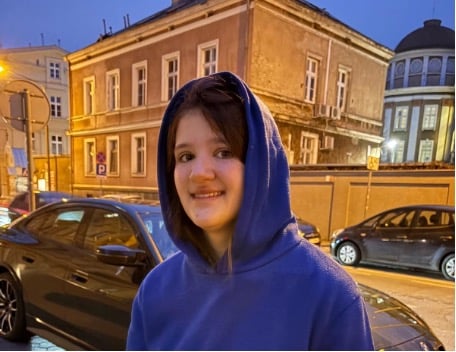
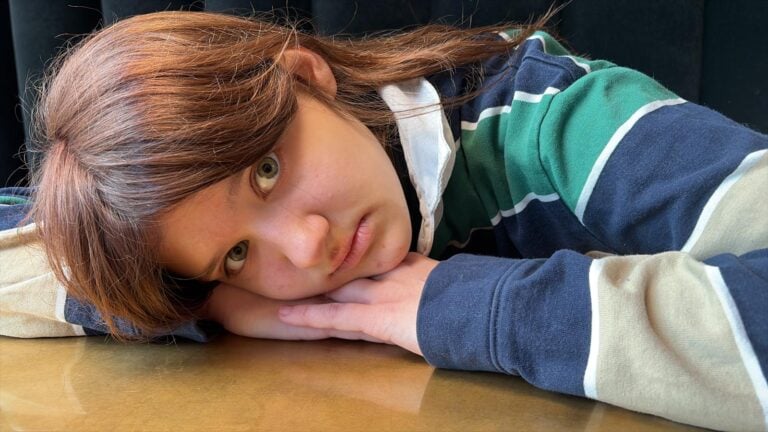
Margaret Athena ‘Meggie’ Hingston, in Poznań, Poland.
Photo by Andrew Hingston.
The disappearance of my daughter is as close as I will ever come. It is mostly mental pain, not physical, but it amounts to the opposite of childbirth: absence not presence. Unbirthing, not birthing. Perhaps stillbirth is similar?
I was about to write, “The pain comes in waves.” But it isn’t true. One can see a wave coming, can anticipate its crest and crash, prepare for it.
Have you ever surfed, or watched others surfing? Paddling, looking over one’s shoulder, the positioning to get the most from the oncoming wave. And to ride it with mastery rather than be ridden by it in chaos.
Not so with the pain I feel now. It is much more like sharp, brutal gusts of wind, violent gusts of ill winds, unseen, unanticipated, unprepared for. Blindsided by pain, that’s what it is. I just start crying.
No one sees it coming. A mafia-style hit while sitting in a barber’s chair. I don’t see it but it comes with the force of a freight train.
Alberto Anastasia died in a hale of bullets, so the cliche goes. But I get up each time, diminished but not dead. I pull myself together with the assistance of Shakespeare, the New York Times, and cheap Australian syrah. A lot of syrah.
Neither the Shakespeare nor the New York Times help, exactly. They distract. The syrah doesn’t help either: it just buffers the pain—like morphine. The pain’s still there but it’s in the next room. I can talk to it, but it can’t hurt me (much). “You can’t hurt me much,” I say, as impotent as I have ever been.
My lawyer—who has, mercifully, taken over much of the detail—met with the police today.
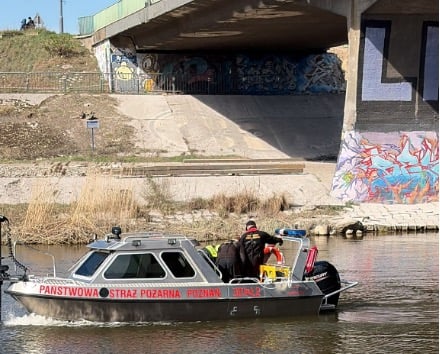
Police in Poznań, Poland, search the Warta river.
Photo by Andrew Hingston.
The police have been searching very diligently. They are now officially searching ‘Europewide,’ but they are pretty sure she has died by drowning in Poznań.
They haven’t found a body yet, but they continue to look in the briskly flowing, spring-swollen river, the Warta, and in its sadder, and much slower, sidelong pools, rivulets and tributaries.
“Don’t give up hope!” many write to me. Do they seriously imagine that it is my choice to hope or not to hope? That is not the question. That’s just how it is, and the answer changes several times an hour.
Today they took away Meggie’s toothbrush for the DNA identification that seems increasingly inevitable. But not certain, not yet.
“Don’t give up hope!” many write to me. Do they seriously imagine that it is my choice to hope or not to hope? That is not the question. That’s just how it is, and the answer changes several times an hour.
I had written to Jacek, one of the co-founders of Zupa,1 a local soup kitchen, to tell him what was going on. He spread the word. I guessed that going there would be good for me. That I would be embraced. I was. Especially by Eva and Sara and Gosia. People who volunteer in soup kitchens are hard-wired for kindness.
Many of the plants in my potted garden have not revivified for spring, as I expected they would. They appear to be dead or dying. They’ve been watered. They’ve been fertilised and they should be going nuts with new growth. They aren’t. These include Meggie’s strawberry plants, one of my hygrangeas, my hibiscus, a lantana, and both my roses. I know it can’t be out of sympathy with Meggie — but it feels that way. My daughter is still ‘missing,’ and now presumed dead. We have no confirmation either way. And now my plants are dying. So, I am volunteering at a Zupa—the soup kitchen—today. Gotta do something or I’ll go crazy.
Update: 20 April 2026
Meggie was finally discovered in the reeds on the bank of the Warta River, not far from the bridge from which she jumped. .
The search was over. My fifteen-year-old daughter was dead.
Afterword, Friday May 1 2026.
Meggie Hingston died by suicide in the Warta river on April 4, 2026. The time, place, and manner of her last rites are still a matter of debate.
The author expressly does not wish to be contacted at this time. -Editor
References:
1. For a detailed description of this soup kitchen see:
Andrew Hingston, There are Always Carrots…Serving Soup in Potato Country, Legacy Magazine, Jan 2026