


By Matt Coddington
Tool-Time, Revisited: A Riveting Column
Ever wonder where the phrase, Ouch! Dammit, dumb ass, that fucking hurts! came from? Whether muttered under the breath or shouted aloud, it was coined by a man who, missing the nail, smashed a finger, crunched a thumb, or otherwise damaged some part of his body by misusing a hammer. I’m a member of that club too and, if you were to string the ensuing cuss words together, they would encircle the earth several times—right alongside my dad’s.
During my elementary-school years in Kent, Washington, I played soccer on The Woodmont Hammers so despite the pain I’ve always had a fondness for this implement.
In this month’s Tool Time, as we continue to build the Ultimate Home Tool Kit, we’ll focus on that mass of heavy metal, the hammer.
The hammer is one of humanity’s oldest tools, and it’s responsible for much of the civilizations we’ve built over thousands of years.
Hammers date back roughly 3 million years in various forms. Anytime you pick up a modern hammer, you’re actually part of an ancient masculine, and human, legacy.
Think about what you might use a hammer for at home – hanging a picture on a wall, assembling a piece of furniture, or repairing a fence. You might make a planter box, install a flagpole, or shape a piece of metal to repair or create something or to move an object in some direction so it fits. The list goes on.
As we continue to build our Ultimate Home Tool Kit, and learn about the history of what we’re putting together, we’ll focus on three types of hammers: the claw; the ball peen; and the mallet.
The Claw

Claw Hammer. Photo by Yousef Samuil
When you’re hammering and realize that your location or measurement is wrong, you’ll need to pull the nail out and try again. But once driven in, how do you pull it out again? That’s where the claw hammer comes in. The claw, two fork-like tines opposite the striking face, allows you to grip the driven nail and pull it out by leverage.
The Ball Peen
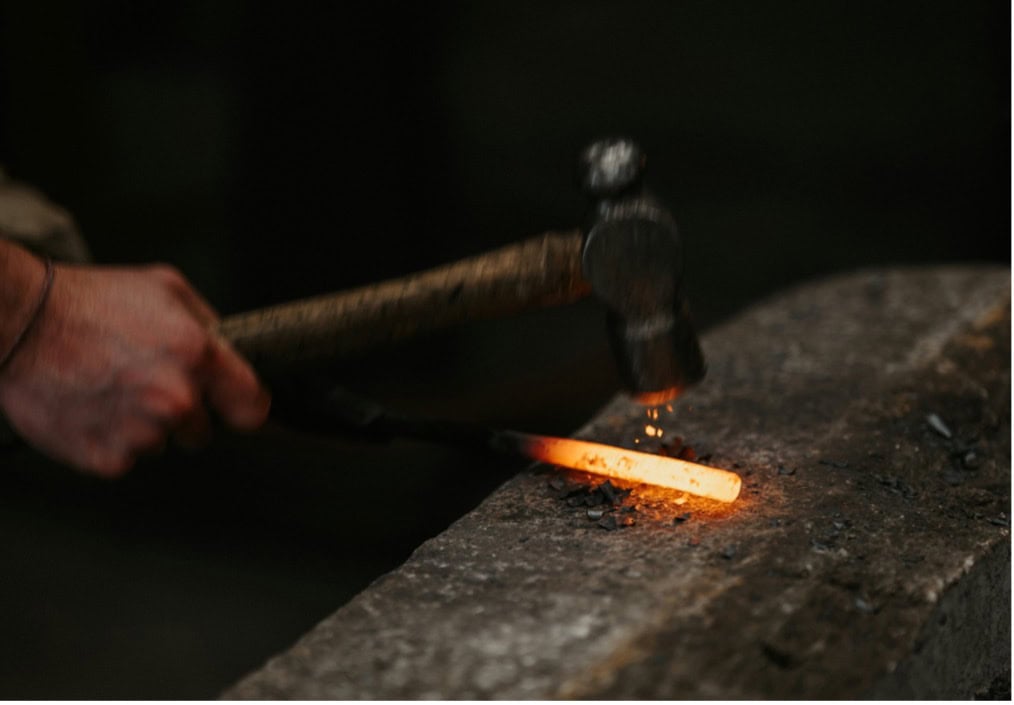
Ball-Peen Hammer. Photo by Martin Baron
If, however, you’re shaping a piece of metal and either need the piece to expand in size, or need a particular shape, that’s where the ball peen hammer comes in. This hammer can certainly drive nails, but the rounded end, the peen, which is derived from Scandinavia for beating metal, will allow you to bend, shape, and flatten metal so you can accomplish your task.
The Mallet
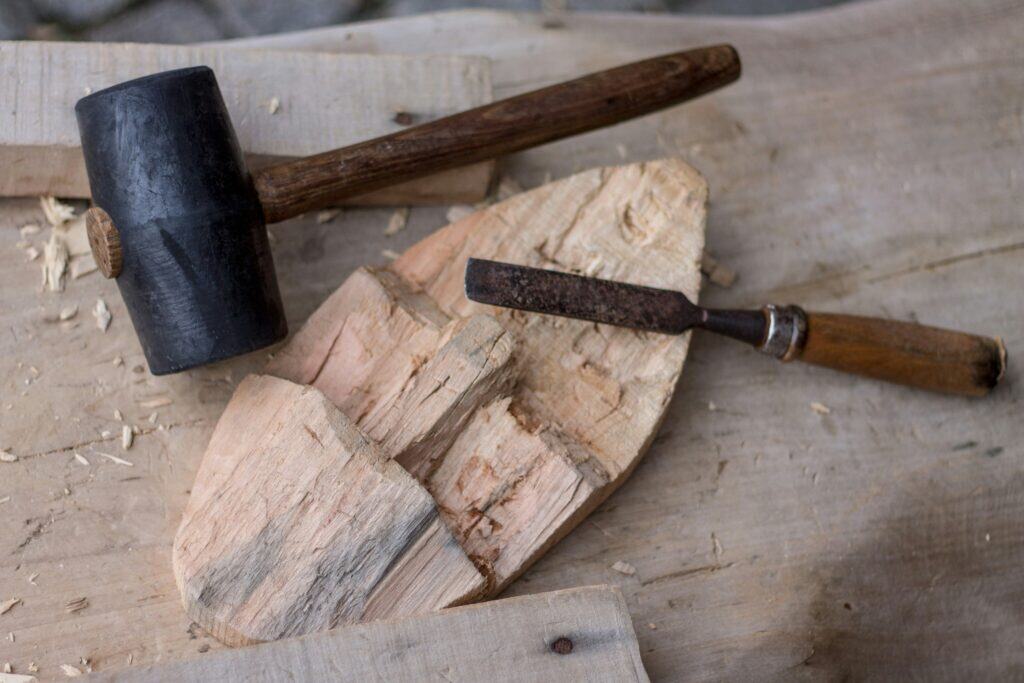
Mallet Hammer. Photo by Orsolya Vékony
If you’re struggling to get something to fit, you might want to try using your mallet to get the thing to move without damaging it.
Two mallets that I use in the course of my work as a commercial lock-and-security technician are a rubber mallet and a dead-blow mallet, which is plastic, hollow, and filled with sand. Both transfer striking force without damage to what they’re striking, and you want that if you can’t get a non-cooperative part to position correctly.
If you need to reposition something by only three-sixteenths or a quarter inch, for example, the mallet does the job. Be aware that you may have to put some muscle into it, or abandon the mallet altogether and put your back into getting the thing to move.
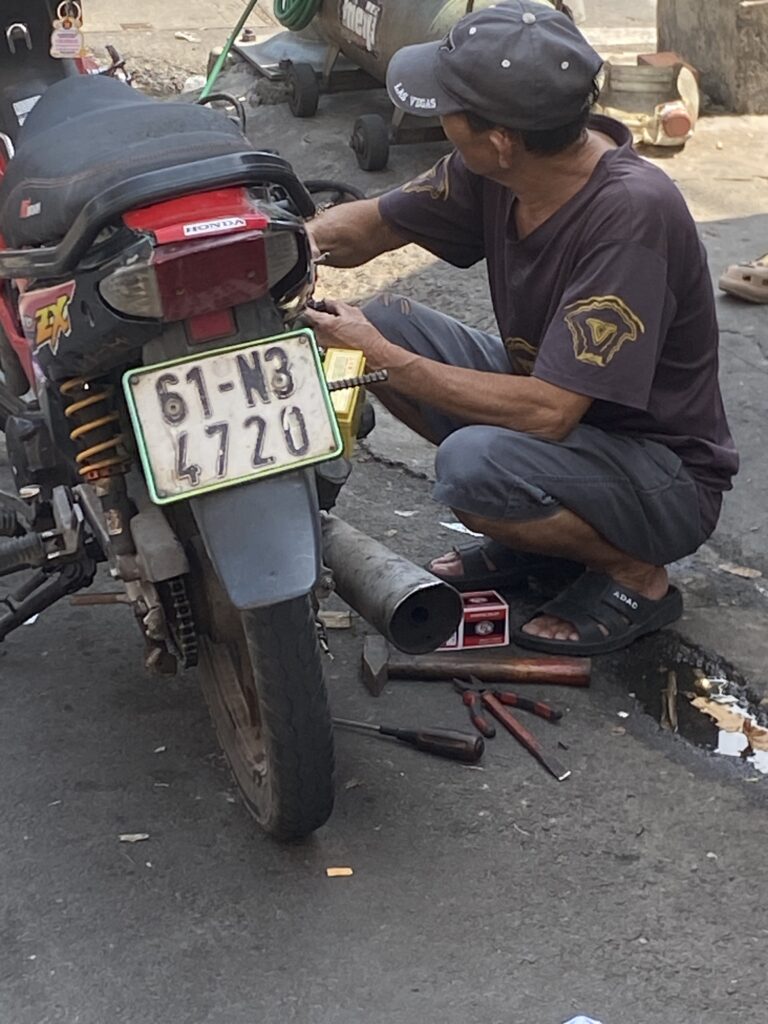
Morotbike repairman in Ho Chi Minh city, Vietnam. Screwdriver, chisel,
and steel hammer are his only tools. Photo by Dan Kempner
Mallets are necessary, but they don’t always work depending on the size, complexity, or real estate of the challenge. They are, however, parts of the Ultimate Home Tool Kit and members of the hammer family, and therefore go in the tool bag.
My main professional uses for mallets are to remove and reinstall storefront glass-aluminum doors when the overhead concealed door closers need replacement. I also use them to smack the door of a safe with a failing electronic keypad. This gets the lock to open one last time so I don’t have to drill through the door—which can be very difficult depending on the safe.
Other uses for hammers have to do with screws. How do the two relate? Well, while hammers don’t turn screws, they can and do help screwdrivers. Sometimes the screw’s opening – the slot – can strip or widen due to repeated use over time. Take the correct screwdriver, place it in the slot, and smack the driver with a hammer. This will recommission the slot so the screwdriver can bite and turn the screw.

Hardware Store, Panjim, Goa, India circa 2018. Photo by Fredericknoronha.
Remember, when it comes to installing or repairing anything, if you’re off by an eighth of an inch, you’re off by an eighth of a mile. It’s not called hardware because it’s easy.
My goal in this column is to not only to focus on tools but also explore qualities of craftsmanship, knowledge, experience, and history, so that all of us, whether professionals or laymen, do a good job, and hopefully, know our way around a toolbox.
About the Author…

Matt