

Dr. Lucas Root, Ph.D.
Guest Writer

“We live in a time that can measure magnitude
instantly and mistake it for greatness.
That is the central pathology.”
I. THE WORD ITSELF
There are words we use so casually that we forget they contain whole civilizations. “Great” is one of them.
What is ‘greatness’?
We use the word constantly and examine it almost never. After the walls and the kings and the mower and the prune tree, here is what it actually means—and what it costs.
It appears everywhere in modern speech, doing a dozen jobs at once—praise, filler, exaggeration, ceremony, shorthand. A meal is great. A song is great. A weekend is great. A leader, a civilization, a scientist, a grief, even a wall is great. We lean on the word as if it were simple, and perhaps because we lean on it so hard, we rarely stop to ask what it is actually measuring.
The word is less a single measure
than a crowded chamber of measures.
But once the question is asked seriously, the word stops being decorative and becomes directional. It matters what we mean. If greatness is to serve as an aim, and not merely an ornament of speech, we have to let the word open back up.
The first thing I notice, as I linger, is that ‘great’ doesn’t refer to one thing but to families of things. The Great Wall of China is great in one sense; Alexander the Great in another; a great mind in another still. A great civilization, a great work of art, a great father, a great betrayal, or a great tragedy, even a great awakening—these are not judged by the same instrument, though they borrow the same adjective.
One of the quiet confusions of our age is that we regularly
use the metrics of one kind of greatness to judge another.
Sometimes ‘great’ means large. Sometimes excellent, sometimes historically consequential. Sometimes, perhaps, it means morally admirable, or simply intense—great joy, great suffering, great hunger. The word is less a single measure than a crowded chamber of measures.
One of the quiet confusions of our age is that we regularly use the metrics of one kind of greatness to judge another. We use scale to judge character. We use fame to judge wisdom. We mistake applause for evidence.
II. SCALE WITHOUT WORTH
The Great Wall is great by ambition, by labor, by engineering scope, by civilizational endurance. You can stand before it and feel your own proportions rearrange: its greatness is monumental. But that category of greatness tells us little, by itself, about moral virtue. A thing may be great in extent without being great in the sense of goodness. It may be immense, astonishing, historically decisive, and still leave unanswered the question of whether it was just, humane, or wise.
A great scientist, by contrast, may never produce anything monumental in the literal sense. The laboratory may be modest, the life almost hidden. The greatness lies elsewhere: in rigor, in perception, in disciplined honesty before reality, in the capacity to see pattern where others see noise, or in the refusal to fake certainty. Here, greatness migrates from mass to weight—not physical weight, but symbolic and civilizational weight.
And then there are the figures to whom history attaches the epithet itself, “the Great,” as if the matter had been settled. Alexander and Cyrus are such cases. In historical usage, “the Great” often means something like epoch-making, world-altering, map-redrawing. Extraordinary consequence. But extraordinary consequence is not moral endorsement.
This becomes clearer in the figures for whom we hesitate to use the term, even when the criteria of historical consequence would seem to qualify them. Hitler changed the world at a scale difficult to overstate. Yet no morally serious person calls him “great” in the honorific sense. That refusal is not inconsistency, it’s moral intelligence—the refusal to collapse consequence into worth.
Mao presents a more charged case. Within certain frameworks, he is absolutely treated as great: state-founding, nation-shaping, epochal. Outside those frameworks, where one foregrounds mass death and human cost, the title fractures. The disagreement tells us something essential: “great” is never merely descriptive. It is also a verdict. And verdicts reveal the values of the judge.
Genghis Khan complicates the matter further. If one were measuring only by territorial impact, military innovation, and civilizational reorganization, “the Great” would seem almost mechanically applicable. Yet popular memory in much of the modern West does not generally grant him that epithet in the way it grants it to Alexander or Catherine. Why not? Because epithets are not just measurements; they are acts of cultural storytelling—selections of what later societies choose to dignify.
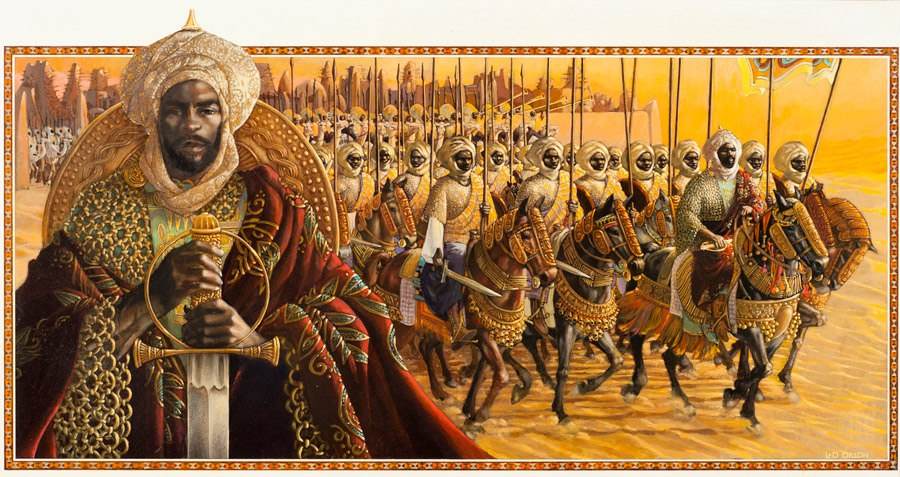
Then there is Mansa Musa (above) who, by nearly any expansive civilizational measure deserves to appear in more conversations about greatness than he does in standard Western narratives. Wealth, influence, statecraft, architecture, learning, historical significance—he stands tall in all of them. His relative absence from the common canon tells us less about his stature than about the habits and blind spots of the canon itself.
History can answer what impact occurred. Character must answer whether we are willing to honor it.
III. WHAT THIS HAS TO DO WITH MEN
That, I think, is where men’s work enters the conversation in a serious way. Not in the performative sense of men speaking grandly about legacy, but in the quieter and more demanding sense of learning to distinguish forms of power, forms of achievement, forms of consequence, and forms of worth.
A man can be impressive and untrustworthy; highly productive and inwardly disordered. He can command a room and fail a relationship; be brilliant and dangerous, visible and hollow. He can, by the standards of headlines, be a giant—and by the standards of maturity, be not yet a man.
A man can. . . by the standards of headlines, be a giant—and by
the standards of maturity, be not yet a man.
It might be tempting to say the opposite of ‘great’ is ‘small.’ But small can be beautiful, wise, intimate, precise, sufficient, even elegant. The opposite of greatness, in the sense that matters most in a life, is not smallness, it is misalignment. Hollowness. Power without stewardship. Impact without conscience.
That is why some men become increasingly impressive and increasingly untrustworthy at the same time. It is why some organizations scale while their culture collapses. It is why a man can win publicly while leaking integrity in every private domain.
The antonym of greatness is not smallness. It is fragmentation—performative, self-serving, reckless, unexamined, unreliable.
And now we are getting closer to what Mentor, Discover, Inspire (MDI) means when it says we “cause greatness.” Because MDI, at its best, does not exist to make men famous. It exists to help men become trustworthy—mature enough that families, careers, communities, and teams can grow in strength around them instead of absorbing their chaos. That is a different kind of great.
IV. THE MOWER, THE TREE, AND THE PLAN
To understand that kind, it helps to make the field smaller. Civilizations are too large, empires too distant. Monuments do not talk back and titles can lie. We have to bring the question into domains where cause and consequence become intimate again: a great conversation, a great apology, a great boundary, a great act of restraint, a great mentoring moment, a great standard upheld when no one is watching.
At this scale, something important becomes visible. Greatness is often not an event but a way of operating. It is not always dramatic. It is often load-bearing. It is infrastructural—what allows good things to happen around us with consistency.
We have to bring the question into domains where cause and consequence become intimate again: a great conversation, a great apology, a great boundary, a great act of restraint, a great mentoring moment, a great standard upheld when no one is watching.
I can start the seed with a memory. When my father first got a riding mower I was excited. I already mowed the lawn most of the time, but a riding mower felt less like a tool than an upgrade in jurisdiction. He brought it around back, set it up in the middle of the lawn, and called me out to learn. It was not the first machine I had driven. I’d run a tractor on the farm which, in many ways, was more dangerous. But on the tractor, conditions were constrained; I drove only when we were haying, with adults close enough to intervene and my assignment was simple: drive straight at a consistent speed.
The riding mower was different. Here, I was going to turn, back up, cut, maneuver. More importantly, I was going to do it alone.
We walked through setup and prep. He talked me through the process itself. He knew what machines are. He knew what inattention costs. And when all was said and done, he left me with one final piece of advice which I can still hear, in his voice: no matter what you’re going to do, always have a plan.
He watched me mow that day, and the next time, too. After that he stopped watching, which I now understand was its own form of trust—and perhaps its own form of greatness.
Somewhere that same summer he came home with a brand-new prune tree. We found a place for it together. We dug the hole. We mixed compost and dirt and water into a foul-smelling slurry intended to persuade the tree to live there, root there, thrive there. We poured it in, set the tree, tied it upright, and left it standing as a small promise in the yard.
A few days later it was time to mow again. By then I had done the job enough times to feel more familiar, but I was nowhere near unconsciously competent. I still had to think, still had to plan. At one point I needed to back up. I was at least thirty feet from the new prune tree. There was no urgency, no drama. Even so, I had learned the lesson. Have a plan. So I made one: back up ten feet, brake, turn, continue mowing.

I backed up the ten feet. I was still far from the tree. Then I pressed my foot down hard on the brake pedal, and accelerated backwards. Before I understood what had happened, I was mowing down the prune tree my father and I had planted days before.
I killed the mower, ran inside, and got him. “I planned,” I said, in some combination of panic and sincerity. “And then everything went wrong.”
Frankly, he probably didn’t believe me. I wouldn’t blame him—not then, not now, not knowing what a lovable nightmare I must have been as a child. I can focus almost infinitely on what fascinates me, though things that do not can vanish behind a kind of cognitive weather. My mail piles up. The color of the envelope does not matter. Opening it within three months can feel like a miracle.
But that day in the yard, one thing was true: I had planned.
V. WHAT THE STORY ACTUALLY TEACHES
For years that story lived in me mostly as comedy and embarrassment: a kid making a stupid mistake. A father silently revising his confidence. All that was true enough but with time, another layer became audible. It is that layer—more than the mishap itself—that has come to instruct me about greatness.
The greatness available to me in that moment was not in the elegance of my intention. It was not in the sincerity of, “I meant well.” Greatness, if we are going to use the word usefully, lay elsewhere: in learning to operate reality, not merely imagine it; in matching confidence to competence; in understanding the machine, not only respecting the idea of the machine; in telling the truth after damage; in becoming the sort of person whose planning includes his own limits.
That last phrase has taken most of a life to learn. A child thinks a plan is a desired sequence. A man learns that a plan is also an encounter with contingency: what could go wrong, what do I not yet know? What patterns in me become liabilities when consequences rise, what margin must be left, what matters must be protected first.
A child’s plan says, “This is what I want to do.” A mature plan quietly adds: and here is how I account for the fact that I am not yet who I imagine myself to be in the moment of execution.
The world has a way of teaching us the difference between intended competence and actual competence. If we are lucky, it teaches us in lawns and prune trees before it teaches us in marriages, teams, businesses, and communities.
There is mercy in small-scale consequences, if one has the humility to let them educate him.
This is where the question of greatness becomes legible. Greatness is not first the spectacular act. It is the maturation of one’s capacity to handle ordinary responsibility in ways that become reliable—and then to carry that reliability into larger and larger domains where the stakes increase. A man who cannot be trusted with a mower and a tree should not be trusted with a team. A man who cannot tell the truth after a mistake should not be trusted with power. A man who confuses intention for competence will eventually injure more than landscaping.
At this scale, the essence begins to show itself. A person is given some measure of power, however small. He is given instruction. He is given trust. He acts. He errs. Something living is harmed. He reports honestly. He learns. He becomes more trustworthy. That, to my mind, is greatness in seed form—not because it is glamorous, but because it is formative.
VI. MATURE MASCULINE STEWARDSHIP
It is also, I suspect, much closer to what MDI means when it speaks of causing greatness. Not a call to become “the Great” in the historical or imperial sense. A call toward mature masculine stewardship—toward becoming men who can be trusted with increasing levels of life: with a conversation, a commitment; perhaps a team, a child, or a marriage; a conflict, a standard, a younger man’s confusion, or an older man’s legacy.
That kind of greatness does not arrive by title. It arrives by repetition—by mentorship, by correction, by staying in the room, by hearing what you do not want to hear, by planning better, by learning your own pedal confusion, by repairing what you break, by learning to carry power without making other people pay for your unconsciousness.
This is where MDI, Sterling, Landmark, the old Men’s Divisions International, and many other men’s development traditions converge: they believe greatness is cultivable. I agree, but I would sharpen the point. Greatness is not merely cultivable: it is trainable under consequence. And the consequence matters, because without consequence, we are often only performing growth.
Greatness is not the enlargement of a man’s image,
but the maturation of his capacity.
If I had to put language to what MDI hopes to mean—at its best, beneath the website language, inside the team-meeting aspirations—I would say: greatness is not the enlargement of a man’s image, but the maturation of his capacity. Not just his ability to produce results, but his ability to produce results without scattering avoidable harm through ego, vanity, carelessness, or immaturity. Not just his ability to lead, but to lead in a way that leaves people stronger. Not just his ability to win, but to win without becoming unusable to the people who depend on him.
MDI says families, careers, communities and that triad is wise because it refuses the fantasy that greatness in one domain compensates for disintegration in another. A man may be celebrated in career and catastrophic at home; eloquent in public and absent where his word is most needed. If there is a mature concept of greatness worth preserving, it must be one that survives contact with ordinary life. Not perfection—integration.
A man can win publicly while leaking integrity in every private domain. The triad of families, careers, communities refuses the fantasy that greatness in one compensates for collapse in another.
VII. BECOMING USABLE
When I consider what I want greatness to mean in my life now, the center of gravity has shifted. I once associated it more naturally with scale. Life has corrected that association, as life tends to do, by introducing complexity, consequence, promises, systems, fragility, and time. It has taught me that the larger the arena, the more expensive unconsciousness becomes. And so I think less now in terms of being seen, and more in terms of being usable.
I want to be the kind of man through whom good things can reliably pass. Intelligence in service of reality rather than performance. Ambition matured into stewardship. Strength that makes others safer rather than smaller. Planning that includes my blind spots. Mistakes that become compost rather than recurring architecture. I want, quite literally and metaphorically, the trees I plant to live.
That desire returns me, unexpectedly and necessarily, to the boy on the mower and the father in the yard. “No matter what you’re going to do, always have a plan,” he said, and it remains excellent advice. But if I were to gloss it now, after years of confusing intention with preparedness and paying to learn the difference, I would add this:
If you want greatness, grow beyond the child’s version of planning. Plan for reality. Plan for consequence. Plan for your own patterns, for what is alive around you—because the tree you planted days ago is alive, and it has no idea what you intend. Plan for the fact that sincerity is not enough. Plan to become the kind of person whose plans survive contact with the machine. And when they do not—because sometimes they will not—tell the truth, repair what you can, and allow even that failure to become part of your apprenticeship.
After all the walls and kings and scientists and epitaphs, after the moral arguments and the mower and the prune tree, my answer is both simpler and more demanding than the word first suggests:
Greatness is mature, trustworthy power in service of life. Or, plainer still: what happens when ability, responsibility, and integrity remain aligned under consequence.
That kind of greatness may, in rare cases, build a civilization. More often, and more importantly, it keeps faith in the domains where civilizations are actually made and sustained: homes, teams, friendships, shops, institutions, and communities; the small, repeated moments where power is exercised, harm is either prevented or caused, truth is either spoken or avoided, and a man becomes—over time—either more trustworthy or less.
The wall and the tree belong to the same moral world. The empire and the mower do, too. The word ‘great’ stretches across them both, but only wisdom tells us which form we are praising.
And if I have any ambition left for the word in my own life, it is not to wear it as a title. It is to earn, in the quieter sense, the trust of those who must live with the consequences of my power.
Dr. Lucas Root is a Ph.D. strategist, builder, and operator known for architecting Pokémon’s half-billion-dollar vending network. Today, he works with founders, investors, and leaders to scale AI-driven systems, communities, and ventures with precision and depth.